
You did the hard part. You got through prostate surgery, focused on cancer control, and kept moving through appointments, recovery, and follow-up. Then a quieter question started taking over your thoughts: Will my erections come back? For many men, that question is harder to ask than it should be.
If you're dealing with erectile dysfunction after prostatectomy surgery, your concern is justified. This isn't rare, and it isn't a sign that you failed recovery. The incidence can range from 30% to 98%, and a landmark JAMA study found that nearly 60% of men reported impotence at 18 months after surgery, including men who had nerve-sparing procedures, according to Fred Hutchinson Cancer Research Center's summary of the JAMA findings.
What matters now is what you do next. Some men are told to wait, try a pill, and hope for the best. That approach can help, but it doesn't tell the full story. Recovery isn't only about getting an erection in the moment. It's also about protecting blood flow, preserving tissue health, and making smart decisions during the months when your body is trying to heal.
Table of Contents
- Navigating Life After Prostatectomy Surgery
- Understanding Why ED Happens After Prostate Surgery
- Your Recovery Timeline What to Expect and When
- The Standard Playbook for Penile Rehabilitation
- Exploring Penile Implants A Definitive Solution
- A Regenerative Approach to Restoring Natural Function
- Taking Control Your Next Steps with SWCA
Navigating Life After Prostatectomy Surgery
A common scene plays out a few weeks after surgery. The pathology is reviewed. The incisions are healing. Family members are relieved. Then, in private, a man notices that sexual function has changed completely, and nobody prepared him for how personal that loss would feel.
That reaction deserves respect. Erectile dysfunction after prostatectomy surgery doesn't just affect sex. It can affect identity, confidence, partnership, and the way a man relates to his own body. Many patients tell themselves they should just be grateful the cancer was treated. Gratitude and grief can exist at the same time.
The medical reality is clear. This is a common consequence of a life-saving operation, not a personal weakness. If you're also noticing tension, avoidance, or miscommunication with a partner, emotional support can be just as important as physical treatment. Some couples benefit from holistic therapy for intimacy concerns while the physical side of recovery is unfolding.
What men often fear most
Most men aren't only asking whether an erection will return. They're also asking:
- Is this permanent
- Did the surgery fail me sexually even if it cured the cancer
- Am I supposed to wait or start treatment now
- Will medication be enough
- What happens if nothing works
Those are practical questions. They need practical answers.
Clinical reality: After prostate surgery, the worst thing a man can do is assume silence equals hopelessness. This problem is common, expected, and worth treating early.
What a productive mindset looks like
The men who approach this period most effectively usually do three things. They stop blaming themselves. They learn what happened to the nerves and blood vessels during surgery. And they treat recovery as an active process, not a passive waiting period.
That approach doesn't guarantee a specific outcome. It does give you the best chance to protect function, preserve tissue, and choose the right intervention at the right time.
Understanding Why ED Happens After Prostate Surgery
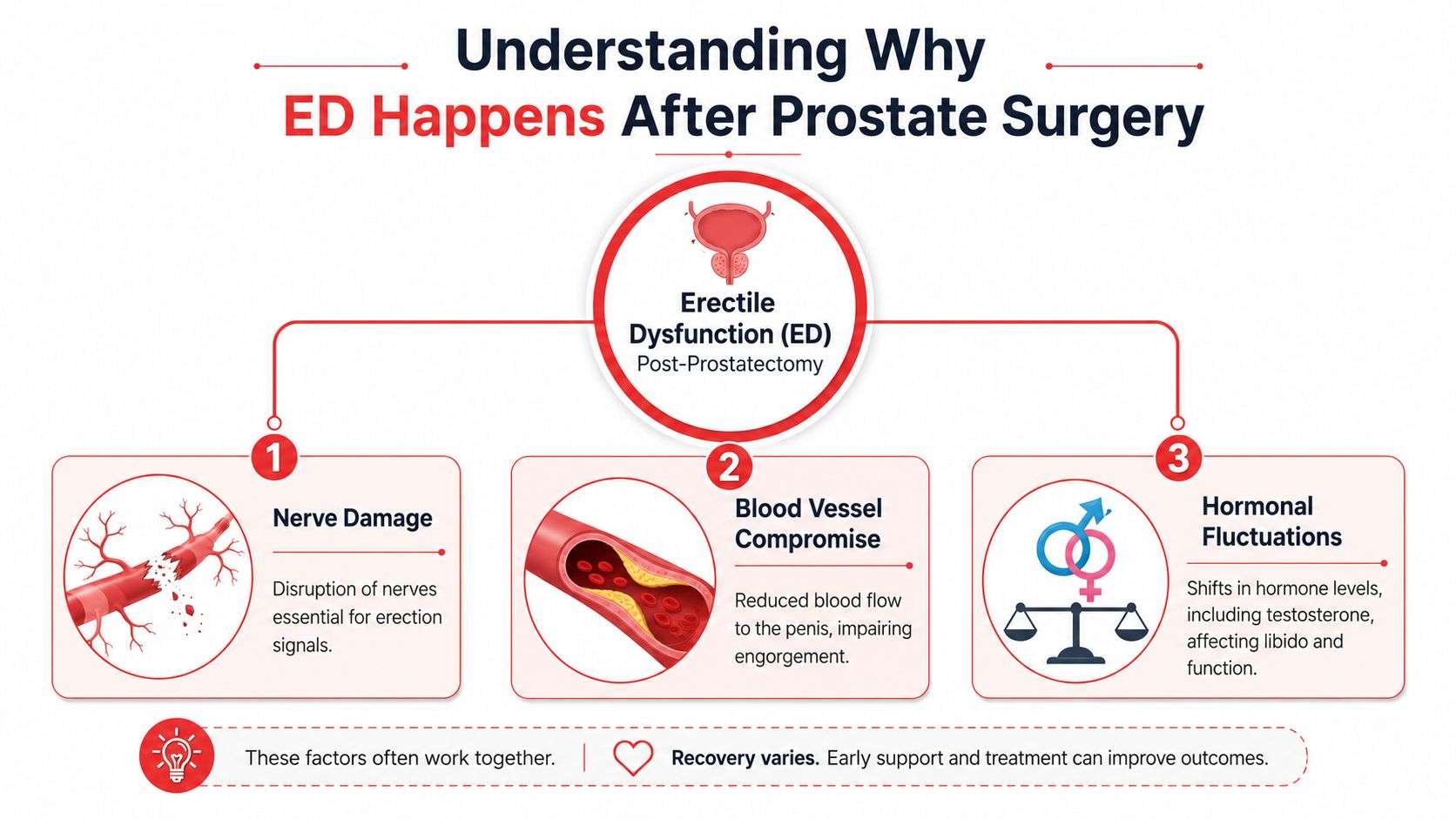
The penis depends on signaling and blood delivery working together. When either part is disrupted, erections weaken. After prostate surgery, both systems can be affected.
The nerves are injured even when they are preserved
The erection nerves sit very close to the prostate. Even in a carefully performed nerve-sparing procedure, those delicate structures can be stretched, bruised, heated, or temporarily stunned. A useful analogy is electrical wiring in a wall. If the wire is cut, the signal is lost completely. If the wire is frayed or compressed, the signal may still return, but not right away and not predictably.
That temporary nerve shutdown is often described clinically as neuropraxia. Patients don't need the term as much as they need the meaning. The message from the brain to the penis is interrupted, so the machinery for erection doesn't get a clear command.
Blood flow problems change the tissue itself
Nerves are only part of the story. Erections also require healthy blood vessels and responsive erectile tissue. Surgery can reduce blood flow in the short term, and when erections stop happening regularly, the penis misses the oxygen-rich circulation that normally helps maintain tissue health.
Without regular inflow, the tissue can become less elastic and less responsive. That's where men get into trouble if the plan is only to wait. Weak signaling can improve over time, but tissue that has become scarred or poorly oxygenated is harder to restore.
A pill may help produce an erection on demand. It doesn't automatically solve the deeper problem of tissue deconditioning after surgery.
Hormonal shifts can affect libido and overall sexual interest, but for most men after prostatectomy, the major drivers are nerve trauma and reduced blood flow. Once patients understand that, the recovery plan makes more sense. The goal isn't merely to chase an erection. The goal is to support healing while also protecting the tissue that has to respond when the nerves recover.
Your Recovery Timeline What to Expect and When
A common scene plays out a few weeks after surgery. The catheter is gone, the pathology discussion is over, and then the next fear shows up. "Why is nothing happening, and is this permanent?"
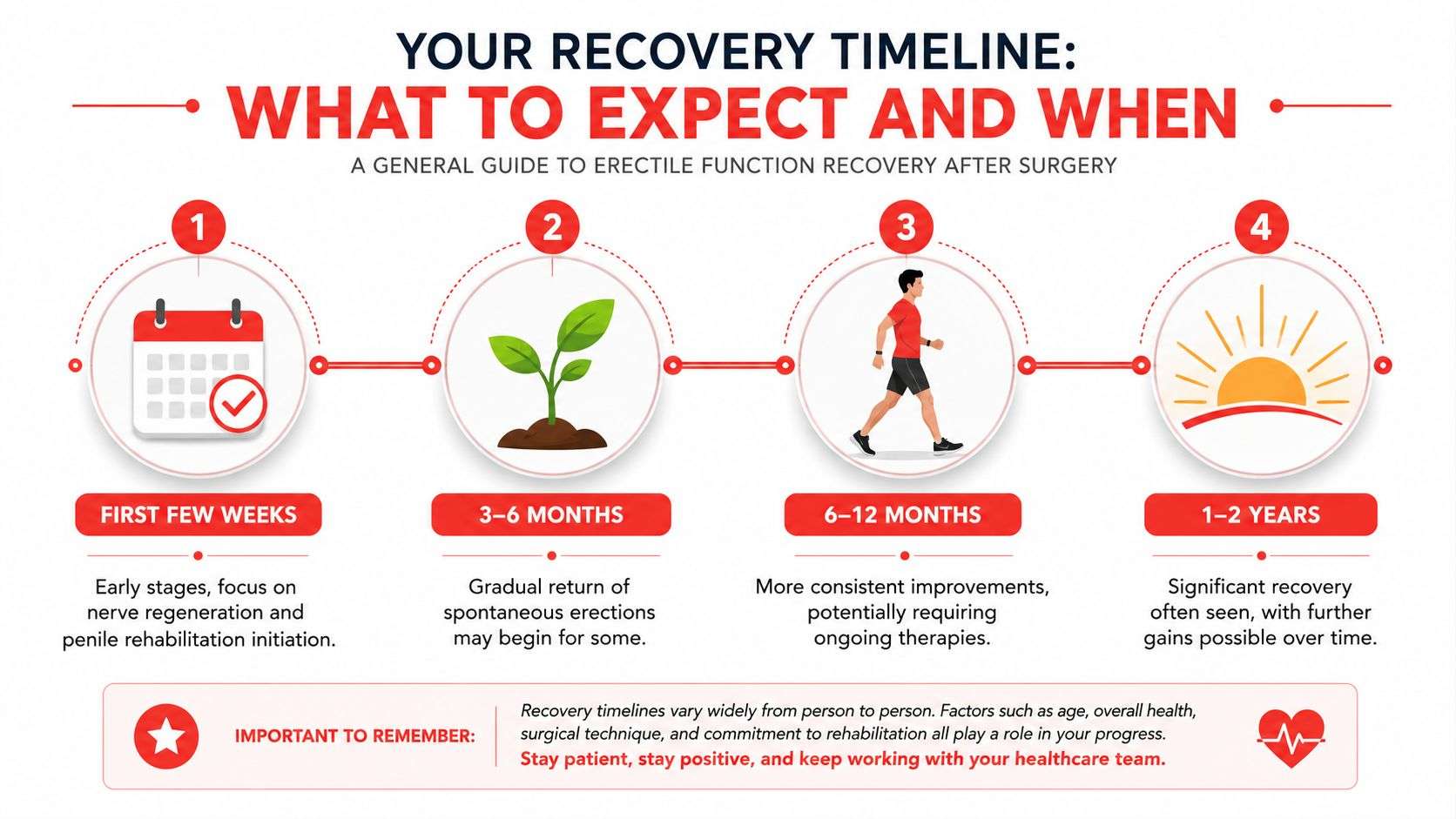
That question deserves a clear answer. Erectile recovery after prostatectomy usually takes months, not weeks, and the timeline is rarely smooth.
The first stretch is often the hardest emotionally
In the early weeks and months, many men have no spontaneous erections at all. Even men who had strong function before surgery can see a sharp drop. That is frightening, but it is still within the expected recovery pattern.
The longer view matters. The American Cancer Society's overview of erection problems after prostate surgery explains that recovery of erectile function can take up to 2 years or longer, and outcomes depend heavily on age, preoperative function, and whether the nerves beside the prostate were spared. That is why I tell patients not to judge their final outcome by the first few months.
If you want a broader look at duration, patterns, and why symptoms can persist, read more about how long erectile dysfunction symptoms can last.
What usually happens over time
The first phase is about healing from the operation itself. Energy is lower, urinary recovery is still taking attention, and sexual function often feels absent. This is also the window when waiting passively can create problems, because erectile tissue does not do well when it goes too long without healthy oxygen-rich blood flow.
The middle phase is less dramatic but more informative. Some men begin to notice partial fullness, brief morning response, or erections that are not yet reliable enough for intercourse. Those small changes matter. They often signal that recovery is underway, even if function is still far from where you want it to be.
The later phase is where decisions become more important. Men who are improving need a plan that supports further recovery. Men who are not improving need a plan that does more than watch and hope. The trade-off is simple. Short-term patience is reasonable. Long periods of inactivity can allow tissue quality to decline, which makes natural recovery harder later.
Your personal timeline depends on a few factors
Some variables are set by the time surgery is done. Nerve-sparing technique matters. Baseline erectile function matters. Age, vascular health, diabetes, smoking history, and other circulation issues also affect how much recovery potential the body has.
Other factors are still in your control. Men tend to do better when they start rehabilitation early, stay consistent, and speak up when the current plan is not producing enough response. Embarrassment delays care. Delay can also mean more tissue loss during a window when preservation matters most.
A practical way to frame the timeline is:
- First months: heal, set realistic expectations, and begin protecting erectile tissue rather than waiting for desire or spontaneous erections to return
- Middle months: watch for signs of responsiveness, even if erections are incomplete or inconsistent
- Longer recovery period: build on progress if it is happening, and if it is not, consider stronger strategies aimed at tissue preservation and restoration
The goal in these months is not just to get through them. The goal is to keep the penis as healthy and responsive as possible while the body recovers.
That is the part many men are never told clearly enough. Pills can be useful, but the bigger issue after prostatectomy is preserving tissue and blood flow while nerve recovery unfolds. Patients who understand that tend to make better decisions earlier, which can change the quality of recovery over the long term.
The Standard Playbook for Penile Rehabilitation
A man comes back after surgery, tries a pill, gets a partial response once, then nothing the next few attempts. He starts wondering whether recovery is failing or whether he is expecting too much too soon. That uncertainty is common, and it is one reason penile rehabilitation needs to be explained as a plan, not a prescription pad.
Standard treatment usually starts with three categories: oral medication, vacuum devices, and injections. Each has a real role. Each also has limits, especially after prostatectomy, when the bigger problem is often reduced nerve signaling, weaker blood flow, and gradual tissue changes during recovery.
How the usual options compare
| Comparing Standard ED Treatments After Prostatectomy | How It Works | Best For | Considerations |
|---|---|---|---|
| Oral medications | Increase the erectile response when sexual stimulation is present | Men with partial nerve recovery or men early in rehabilitation | May work inconsistently after surgery and can cause side effects such as headache, flushing, or nasal congestion |
| Vacuum erection devices | Draw blood into the penis mechanically | Men who want a non-drug option or tissue expansion support | Can feel awkward, mechanical, or unromantic; some men dislike the constriction band |
| Penile injections | Deliver medication directly to trigger an erection | Men who don't respond adequately to pills | More invasive, requires teaching and comfort with self-injection |
For a practical overview of these categories, see available treatments for erectile dysfunction.
What works well and where each option falls short
Pills are usually the first step because they are familiar and easy to try. In men with at least some preserved nerve function, studies have shown benefit after nerve-sparing prostate surgery, including research summarized by the American Urological Association-guideline). The practical point is simple. Pills help some men, but many still do not get a dependable erection that feels good enough for sex.
Vacuum devices are useful for a different reason. They do not rely on the same degree of nerve recovery, so they can help create rigidity even when spontaneous erections are absent. In practice, adherence is the challenge. Some men appreciate the predictability. Others stop using the device because it interrupts the moment or the erection feels less natural.
Injections often produce the most reliable erection of the non-surgical options. For men who have poor response to pills, they can be an effective way to restore sexual function while recovery is still evolving. The trade-off is obvious and very real. A man has to learn the technique, tolerate needle use, and accept that intimacy may require more planning.
That is why I tell patients not to judge a treatment only by whether it produces an erection on command. A partial response may still help preserve use. A device that feels mechanical may still support blood entry and stretch the tissue. An injection may restore intercourse, but it does not repair the underlying injury from surgery.
A clear summary looks like this:
- Medications are convenient: Easy to try, but response after surgery can be inconsistent.
- Devices create firmness mechanically: Helpful when nerve recovery is limited, but not every man likes using them.
- Injections improve reliability: Often effective when pills fail, but they require comfort with self-treatment.
The standard playbook matters. It gives men options, keeps intimacy from disappearing completely, and can reduce the sense of helplessness that often follows prostatectomy. But symptom management alone is not the whole rehabilitation story. The men who do best long term usually think beyond short-term performance and ask a better question early: how do I protect and rebuild erectile tissue while healing is still in progress?
Exploring Penile Implants A Definitive Solution
When conservative treatment doesn't give a man a usable erection, penile implants deserve a straightforward discussion. They are not a last resort in the emotional sense. They are a definitive mechanical solution for men who want reliability after other options have failed or become exhausting.
Who usually considers an implant
The typical candidate is a man with persistent erectile dysfunction after prostatectomy surgery who has had an adequate trial of pills, devices, injections, or some combination of them. He may be tired of unpredictability. He may want spontaneity back. He may want a treatment that doesn't depend on uncertain nerve recovery.
This option also suits men who are less interested in ongoing rehabilitation and more interested in a dependable functional result. That isn't giving up. It's choosing certainty over prolonged frustration.
What daily life is like with one
An implant is placed surgically inside the penis. Inflatable devices are designed to create an erection when the man activates the pump mechanism. When not in use, the penis remains in a resting state. The goal isn't to restore the original biological erection pathway. The goal is to create a controlled, reliable erection for intercourse.
Men usually ask the same practical questions:
- Will it look natural enough
- Will it feel usable in real life
- Will my partner notice
- Will I still have orgasm if I could before
- Am I comfortable having a device rather than chasing natural recovery
The right question isn't whether an implant is dramatic. The right question is whether the current treatment path is giving you a sex life you can actually live with.
Implants aren't for everyone. They require surgery, recovery, and acceptance of a permanent device-based solution. But for the right patient, they remove uncertainty in a way no pill or injection can.
A Regenerative Approach to Restoring Natural Function
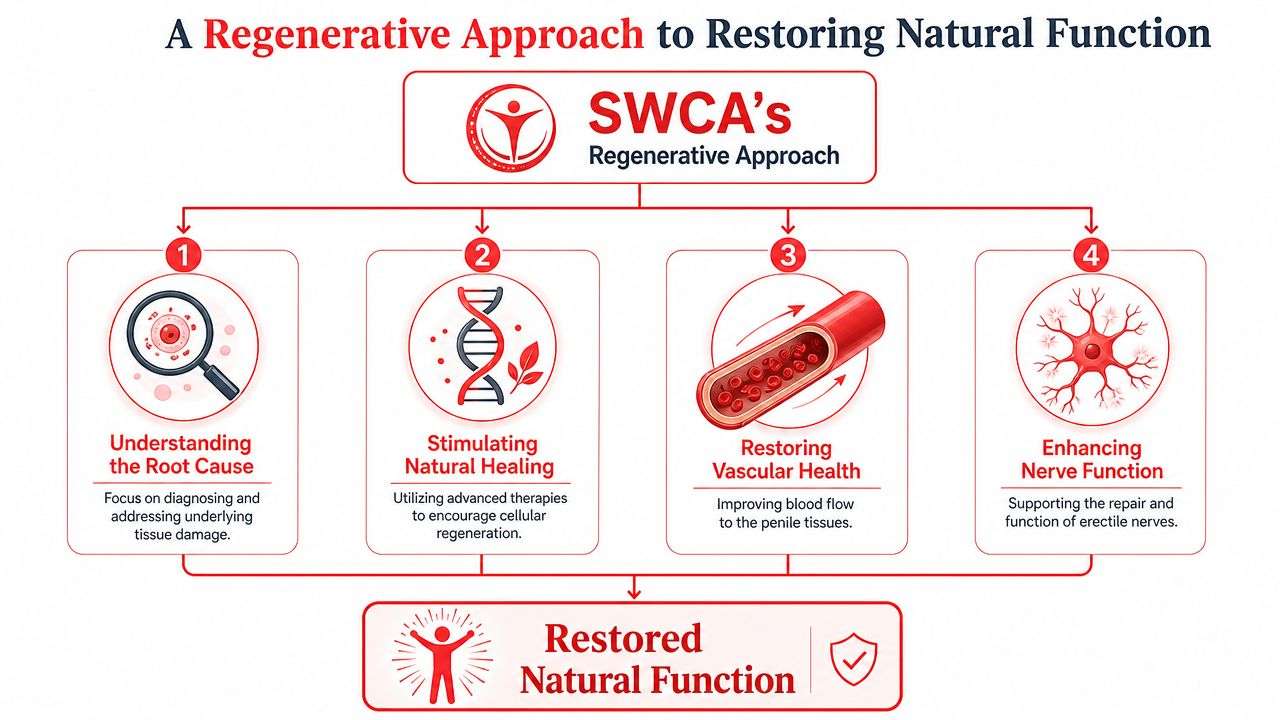
Standard rehabilitation often focuses on producing erections while the nerves heal. That approach has value. It doesn't fully address what happens to erectile tissue when normal blood flow and nighttime erections drop off after surgery.
Why timing matters more than most men realize
After prostatectomy, many men lose nocturnal erections. That matters because those episodes aren't just about sexual activity. They help maintain oxygenation and tissue quality. According to Brown Health's overview of erectile dysfunction after prostate surgery, post-prostatectomy ED can lead to a lack of nocturnal erections, causing tissue hypoxia and atrophy. The same resource notes that regenerative protocols such as acoustic wave therapy can mechanically stimulate blood flow and tissue repair factors, offering a preventive strategy to reverse fibrosis and preserve erectile tissue before the 12-month nerve recovery window closes.
That point changes the conversation. If a man waits passively while the tissue becomes less healthy, he may still have nerve improvement later but a weaker structure to respond with.
If you're interested in the biologic rationale behind vascular and nerve support, this discussion of BPC-157, nerve regeneration, and blood flow adds helpful context.
What regenerative protocols are trying to accomplish
A regenerative strategy aims at the tissue itself, not only the symptom in the moment.
Acoustic wave therapy is used to deliver mechanical stimulation into the tissue. The practical idea is to encourage local blood flow and disrupt early micro-fibrotic change before that change becomes more established.
Laser-based tissue therapy is generally positioned as a way to support cellular activity and local repair. The appeal is that it is non-surgical and focused on tissue quality rather than simple short-term performance.
Concentrated regenerative injections are intended to deliver biologically active material directly into the area being treated. In practice, clinicians use this category of treatment when they want a more direct tissue-level intervention.
The trade-off's importance becomes evident. Regenerative care is not an overnight substitute for all other treatments. It is also not best understood as a miracle claim. Its strongest logic is early action. If you can preserve tissue health, improve local circulation, and reduce the progression toward fibrosis while the nerves are recovering, you may improve the conditions needed for a more natural erection later.
That makes regenerative medicine appealing to a specific kind of patient. He doesn't just want a temporary erection. He wants to protect what surgery threatened and recover as much natural function as possible.
Taking Control Your Next Steps with SWCA
Once a man understands his options, the next challenge is acting before discouragement turns into delay. This is usually the point where patients either move forward with purpose or lose months waiting for a spontaneous improvement that may or may not come.
When it makes sense to seek specialty care
Specialty care makes sense if any of the following sounds familiar:
- You're getting little or no response from pills
- You've been told to wait, but no one has given you a structured plan
- Your erections are inconsistent enough that intimacy feels stressful
- You're worried about loss of sensitivity, length, or tissue quality
- You want to explore non-surgical options before considering an implant
A focused sexual wellness evaluation should look beyond the erection itself. It should consider surgical history, pre-operative function, current symptoms, blood flow issues, hormone status, and the difference between producing a temporary erection and preserving long-term function.
How to prepare for your next appointment
Men do better when they show up with specifics, not vague frustration.
Bring a short timeline of your surgery and recovery. Note whether your procedure was nerve-sparing if you know that detail. Write down what you've already tried, whether the issue is firmness, duration, desire, or all three, and whether there are any partial signs of recovery.
A useful appointment checklist includes:
Current function
Can you get any spontaneous erection at all, even partial or brief?Treatment response
Did pills, devices, or injections help, and in what way?Tissue concerns
Have you noticed changes in length, sensitivity, or fullness?Relationship goals
Are you trying to restore intercourse, improve confidence, or preserve future function while healing continues?
Men often wait for the "right time" to ask for help. After prostate surgery, earlier and more structured care is usually better than vague reassurance.
The best next step is a consultation that treats this as both a medical and quality-of-life issue. That means a thorough review, relevant lab work when appropriate, and a personalized plan rather than a one-size-fits-all prescription.
If you're dealing with erectile dysfunction after prostatectomy surgery and want a plan that goes beyond symptom management, Sexual Wellness Centers of America offers evaluations and regenerative sexual wellness care designed to help adults pursue stronger function, healthier tissue, and a more confident recovery path.