
Understanding the Serious Risks of Gluteal Injections
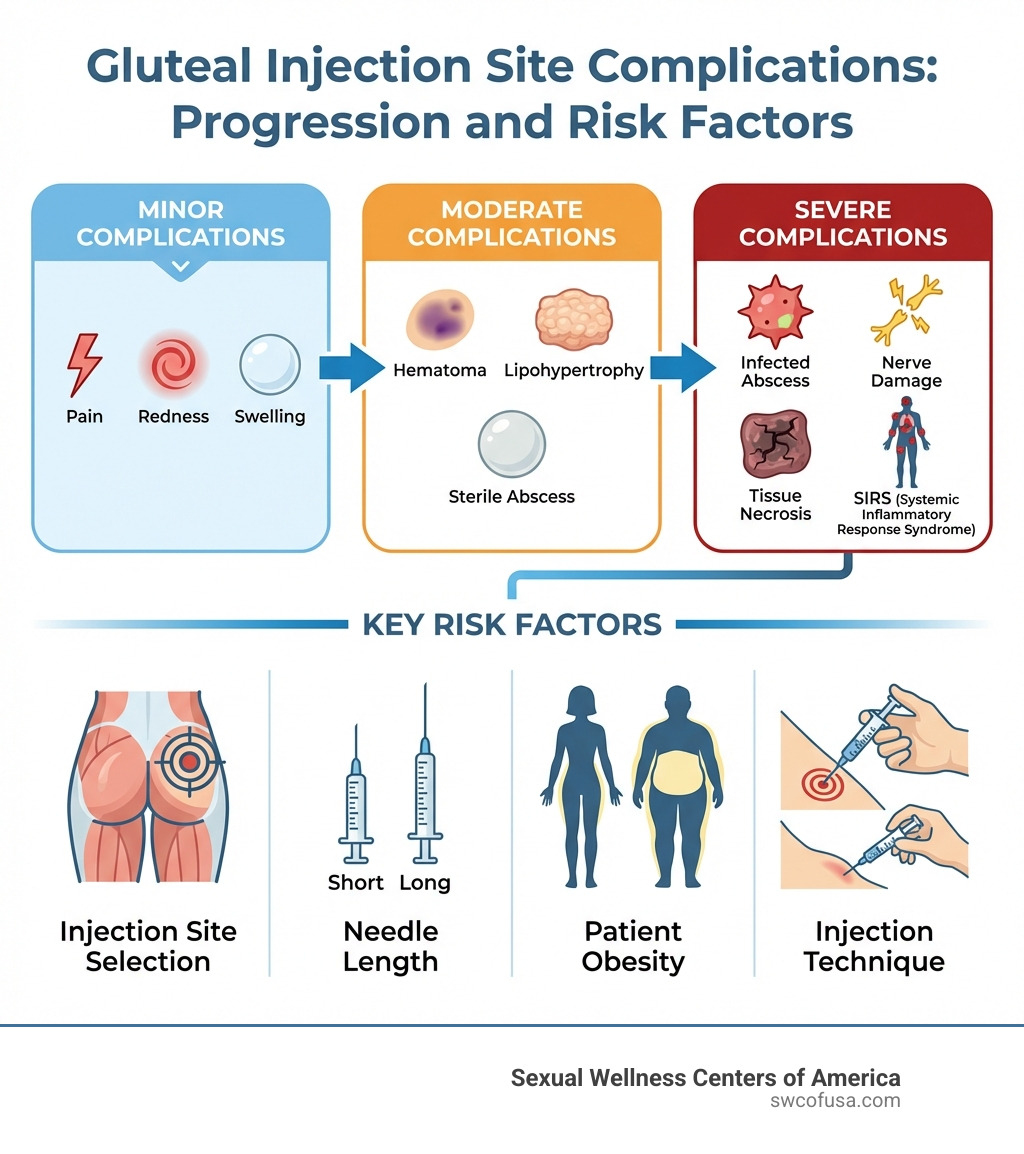
Complications from gluteal injection sites range from minor pain and bruising to life-threatening conditions like nerve damage, abscesses, and tissue necrosis. While intramuscular injections in the buttocks are commonly used for medications, hormones, and therapeutic treatments, they carry distinct risks that every patient should understand before proceeding.
Common complications include:
- Lipohypertrophy – Fatty tissue buildup from repeated injections, affecting up to 64% of patients who receive regular injections
- Nerve damage – Particularly sciatic nerve injury, which can cause pain, numbness, or paralysis
- Abscesses and infections – Both sterile and bacterial, with the potential to progress to sepsis
- Hematoma – Bleeding and blood pooling, especially from superior gluteal artery injury
- Nicolau syndrome – A rare but severe condition involving tissue necrosis and skin death
- Granulomas – Hard lumps of calcified or fibrotic tissue at the injection site
- Muscle fibrosis and contracture – Long-term muscle damage resulting from repeated injections
The severity of these complications depends heavily on where the injection is placed. Studies show that dorsogluteal (upper outer buttock) injections carry significantly higher risks than ventrogluteal (hip area) injections. In fact, one review found that out of 670 reported complications over 27 years, none occurred at the ventrogluteal site, while at least 382 occurred in the dorsogluteal region.
Patient anatomy matters tremendously. Research demonstrates that in obese patients, standard needle lengths (3.8 cm) often fail to reach muscle tissue, leading to subcutaneous injection and increased complication rates. True intramuscular delivery is achieved in only 32-52% of cases overall, dropping to just 8% among women.
I’m Jeff Nuziard, CEO of Sexual Wellness Centers of America, and throughout my career helping patients optimize their hormone therapy and sexual wellness, I’ve witnessed how critical proper injection technique is in preventing these complications. Our commitment to patient safety drives us to educate every individual about these risks before beginning any injection-based treatment protocol.
Key Resources for Gluteal Injection Safety:
Understanding Common Gluteal Injection Site Complications
Intramuscular injections in the buttocks can lead to a range of complications, from mild discomfort to serious medical emergencies. Understanding these potential issues is essential for patient safety and effective care, whether you’re receiving hormone therapy, vaccinations, or other injectable treatments.
Lipohypertrophy
One of the most common complications, particularly for individuals requiring regular injections, is lipohypertrophy. This refers to a buildup of fatty tissue beneath the skin caused by repeated injections in the same area. Over time, the body responds to this repeated trauma by forming excess fatty tissue at the injection site.
Lipohypertrophy is remarkably common, affecting as many as 64% of people with diabetes who administer regular insulin injections. The affected area may feel lumpy, firm, or rubbery, and can even become somewhat numb. This reduced sensation can paradoxically lead individuals to prefer these areas for future injections since they feel less painful, which inadvertently worsens the condition.
Beyond the cosmetic concern, lipohypertrophy can significantly affect how your body absorbs medication. When insulin is injected into a lipohypertrophic area, absorption becomes unpredictable, leading to fluctuating blood sugar levels. This increases the risk of serious issues like diabetic ketoacidosis, hyperglycemia, and hypoglycemia, and may even require higher medication doses to achieve the same effect.
Sterile Abscess
A sterile abscess is a localized collection of pus that forms without bacterial involvement. It is often caused by the irritating nature of certain medications or solutions when injected into the muscle. While not infected, these abscesses can still cause significant pain, swelling, and discomfort. They typically require drainage, similar to an infectious abscess, but without the need for antibiotics.
Hematoma
A hematoma is a collection of blood outside of blood vessels, often appearing as a bruise but potentially much larger and deeper. This occurs when a needle punctures a blood vessel during injection, causing bleeding into the surrounding tissue. In the gluteal region, significant hematomas can develop if larger vessels like the superior gluteal artery are injured. While rare, there have been documented reports of superior gluteal artery injuries due to incorrect injection techniques. One case report described a healthy middle-aged man who developed a severe hematoma and subsequent abscess after a gluteal injection injured his superior gluteal artery, eventually leading to a pre-septic state. For a deeper dive into such severe cases, you can refer to scientific research on injection site hematomas and abscesses.
Granuloma
A granuloma is a small area of inflammation caused by tissue injury, often appearing as a persistent, firm lump. These can form when medication is not fully absorbed or when there is a localized inflammatory reaction to the injected substance. While typically benign, granulomas can be painful or cosmetically undesirable.
Localized vs. Systemic Complications
To better understand the full scope of potential issues, it helps to distinguish between localized and systemic complications:
| Type of Complication | Description | Examples |
|---|---|---|
| Localized | Affects only the injection site or surrounding tissue. | Pain, redness, swelling, bruising, lipohypertrophy, sterile abscess, hematoma, granuloma. |
| Systemic | Affects the entire body, potentially leading to widespread illness. | Sepsis, anaphylactic shock, systemic inflammatory response syndrome (SIRS). |
Identifying infection-related gluteal injection site complications
Infections are among the most serious risks associated with gluteal injections. They can range from localized pyogenic abscesses to severe, life-threatening systemic conditions.
- Pyogenic Abscess: This is a localized collection of pus caused by bacterial infection, often indicated by a painful, red, swollen, and warm lump at the injection site. If left untreated, it can grow, cause significant tissue damage, and potentially spread bacteria into the bloodstream.
- Erythema and Fever: Redness and warmth at the injection site, accompanied by a fever of 100.4°F (38°C) or higher, are key indicators of infection. These signs should prompt immediate medical attention.
- Sepsis: This is a life-threatening condition caused by the body’s overwhelming response to an infection. If bacteria from an infected injection site enter the bloodstream, they can trigger sepsis, leading to organ dysfunction. Symptoms can be subtle at first, including rapid heart rate, confusion, extreme pain, or clammy skin. Early recognition and treatment are critical. There are documented cases of sepsis following intramuscular injections requiring intensive care.
Managing long-term gluteal injection site complications
Some complications from gluteal injections can have lasting effects, impacting quality of life and physical function over months or even years.
- Muscle Fibrosis and Contracture: Repeated injections, especially with irritating substances or poor technique, can lead to fibrous tissue forming within the muscle. This fibrosis can cause the muscle to stiffen and shorten, a condition known as contracture, which restricts movement and can be painful.
- Chronic Pain: Persistent pain at the injection site, sometimes radiating down the leg, can result from nerve irritation, ongoing inflammation, or scar tissue formation.
- Atrophy: In severe cases of nerve damage or chronic inflammation, muscle tissue can waste away, leading to weakness in the affected area.
- Persistent Granulomas: While many granulomas resolve on their own, some can persist for extended periods, remaining palpable and potentially causing discomfort.
Untreated or poorly managed complications can lead to permanent disability, chronic pain syndromes, or life-threatening systemic infections. Sciatic nerve injuries from injections, for example, can result in permanent loss of sensation or motor function in the leg and foot. Research has documented these outcomes in studies on intramuscular injection abscesses and long-term consequences.
Anatomical Risks: Sciatic Nerve and Vascular Safety
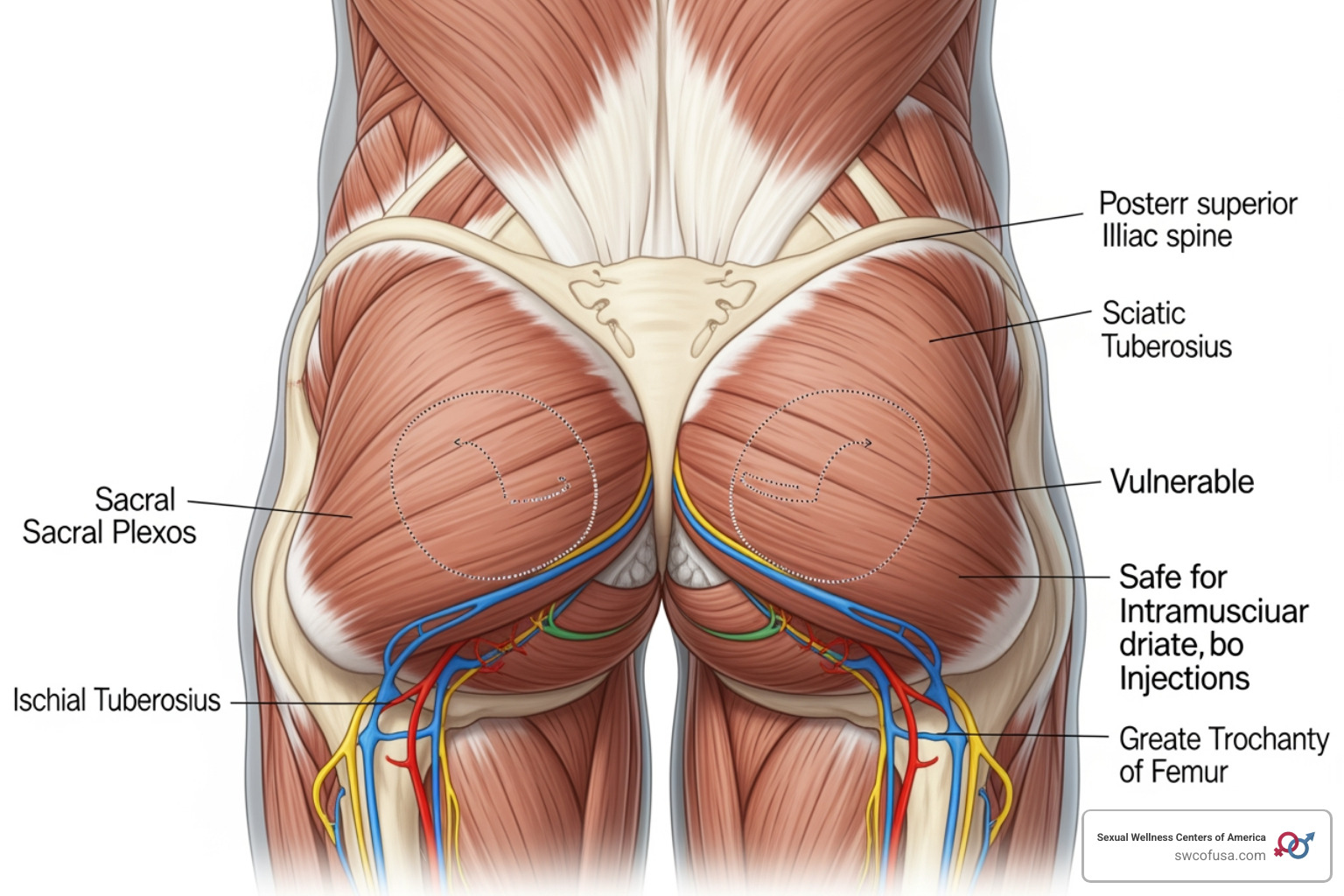
The gluteal region contains critical anatomical structures, making precise injection technique essential for avoiding serious complications.
Sciatic Nerve
The sciatic nerve is the largest nerve in the body, and it runs directly through the buttock. Accidental injection into or near this nerve can lead to a condition known as iatrogenic sciatic nerve injection injury, which may cause:
- Immediate, sharp, shooting pain during the injection
- Numbness or tingling radiating down the leg and into the foot
- Muscle weakness or paralysis, particularly foot drop, which makes it difficult to lift the front part of the foot
- Burning sensations or chronic neuropathic pain
The risk of sciatic nerve injury is one of the primary reasons why certain injection sites are preferred over others. This type of injury can have devastating long-term consequences, significantly impacting mobility and quality of life. Scientific research on sciatic nerve injection injury documents these severe outcomes in detail.
Superior Gluteal Artery
The superior gluteal artery is another crucial structure in this region. While injuries are rare, accidental puncture can lead to significant bleeding and hematoma formation. A hematoma can then become a breeding ground for infection, potentially progressing to an abscess and more severe systemic issues. In very rare cases, injury to this artery can lead to a pseudoaneurysm, which is a pulsating mass formed by blood leaking from the damaged vessel.
Dorsogluteal vs. Ventrogluteal Site Risks
The choice of injection site is perhaps the single most important factor in preventing complications. For decades, the dorsogluteal site (the upper outer quadrant of the buttock) was the standard location. However, this site carries a higher risk due to its proximity to the sciatic nerve and major blood vessels.
- Dorsogluteal Site: Located in the gluteus maximus and gluteus medius muscles, this site has historically been associated with a higher risk of sciatic nerve injury, vascular injury, and subcutaneous fat injection. Studies have shown that even with proper quadrant-method landmarking, the sciatic nerve can be surprisingly close, and the thickness of subcutaneous tissue can prevent the needle from reaching the muscle.
- Ventrogluteal Site: In contrast, the ventrogluteal site is widely recognized as the safest location for gluteal intramuscular injections. Located in the gluteus medius and gluteus minimus muscles, it is identified by placing the heel of the hand on the greater trochanter, the index finger on the anterior superior iliac spine, and spreading the middle finger towards the iliac crest to form a “V” shape. The injection is given in the center of this “V.” The key advantages include:
- Distance from Nerves and Vessels: This site is free from major nerves and blood vessels, significantly reducing the risk of sciatic nerve damage or arterial injury.
- Consistent Muscle Depth: It typically has a thinner layer of subcutaneous fat and a thicker, more consistent muscle mass, increasing the likelihood of a true intramuscular injection.
- Less Pain: Research indicates that injections at the ventrogluteal site are significantly less painful than those at the dorsogluteal site.
A systematic review and meta-analysis comparing these two sites confirmed that the ventrogluteal site is associated with significantly less pain, bleeding, and hematoma. The safety of this approach has been well-documented in scientific research on ventrogluteal site safety. We strongly advocate for the use of the ventrogluteal site for all gluteal intramuscular injections when appropriate.
Prevention and Technique: Reducing Injection Risks
Preventing complications from gluteal injections comes down to meticulous technique and a thorough understanding of each patient’s individual anatomy. It is not just about where you inject, but how you do it.
Needle Length
Choosing the correct needle length is essential to ensure the medication reaches the muscle layer rather than being deposited into subcutaneous fat. Injecting into fat can lead to slower absorption, increased pain, and a higher risk of localized reactions like sterile abscesses or lipohypertrophy.
- The Role of Obesity and Subcutaneous Fat Thickness: Patient anatomy, particularly body mass index (BMI) and subcutaneous fat thickness, plays a significant role in needle selection. For individuals with a higher BMI, a standard 1.5-inch (38 mm) needle may not be long enough to penetrate through the fat layer and reach the muscle. One study found that in obese patients, a 50 mm needle was often necessary to ensure true intramuscular delivery. For overweight women, a 38 mm needle did not guarantee intramuscular injection in all cases. This highlights why a one-size-fits-all approach to needle length is inadequate, and why we always assess patient anatomy before selecting the appropriate needle.
Z-track Technique
The Z-track technique is a simple yet highly effective method to minimize medication leakage into the subcutaneous tissue and reduce skin irritation. Here is how it works:
- Pull the Skin: Before inserting the needle, the skin and subcutaneous tissue are pulled laterally (to the side) by about 1 to 1.5 inches (2.5 to 3.75 cm).
- Inject: The needle is then inserted, and the medication is administered.
- Release: After the injection, the needle is withdrawn, and the skin is released.
This creates a zigzag path that seals the medication within the muscle, preventing it from tracking back into the subcutaneous tissue or onto the skin surface. This technique is particularly beneficial for irritating medications or those that can cause skin discoloration.
For comprehensive information on proper intramuscular injection practices, refer to scientific research on intramuscular injection best practices.
The Role of Aspiration and Needle Selection
Historically, aspiration, which involves pulling back on the syringe plunger after needle insertion but before injecting medication, was standard practice. The goal was to check for blood and ensure the needle had not entered a blood vessel, preventing accidental intravenous injection.
However, current evidence-based guidelines from the World Health Organization (WHO) and the Centers for Disease Control and Prevention (CDC) no longer recommend routine aspiration for most intramuscular injection sites. The reasons for this change include:
- Lack of Supporting Evidence: For common injection sites, there is no strong evidence that aspiration prevents complications, and it can actually increase patient discomfort and anxiety.
- Unreliable Results: The muscle tissue itself is highly vascular. A small amount of blood in the syringe does not necessarily mean a major vessel has been hit, and the needle tip might shift position during the aspiration process.
- Variable Factors: The needle gauge and the pressure applied during aspiration can influence whether blood is detected, making the practice less reliable than once thought.
Despite these updated guidelines, some healthcare providers still perform aspiration, especially at the dorsogluteal site, due to traditional practices or perceived higher risk. However, scientific research on the aspiration debate suggests that for most intramuscular injections, aspiration is not necessary and may even contribute to increased pain.
Needle Selection: Beyond length, the needle gauge (thickness) also matters. While a smaller gauge (thinner needle) may reduce pain, it could be less suitable for viscous (thick) medications. The appropriate gauge is chosen based on the medication’s viscosity and the patient’s comfort. We always use new, sterile needles for every injection to prevent infection and ensure sharpness.
Rare and Severe Complications: Nicolau Syndrome
While many gluteal injection site complications are manageable, some are rare but profoundly severe. Nicolau syndrome, also known as Embolia Cutis Medicamentosa, falls into this category. It’s a devastating complication that can occur after intramuscular (or even subcutaneous) injections, characterized by intense pain, skin discoloration, and ultimately, tissue necrosis (tissue death).
Nicolau Syndrome
Nicolau syndrome typically begins with an immediate, severe burning pain at the injection site, followed by a rapidly spreading, livedoid (lacy, net-like) purplish discoloration of the skin. This can progress to blistering, ulceration, and full-thickness tissue necrosis, affecting the skin and underlying fat.
- Causes and Pathogenesis: The exact cause isn’t fully understood but is believed to involve several factors:
- Vascular Spasm: The injected medication might trigger a severe spasm in local blood vessels, cutting off blood supply to the tissue.
- Direct Vascular Damage: The needle could directly injure a small artery, leading to thrombosis (blood clot formation) and occlusion.
- Perivascular Inflammation: The medication might cause inflammation around the blood vessels, leading to their collapse.
- Drug Properties: Certain medications, particularly non-steroidal anti-inflammatory drugs (NSAIDs) like diclofenac, are more commonly implicated. These drugs can inhibit prostaglandin synthesis, contributing to vascular constriction.
- Inadvertent Intra-arterial Injection: Although rare, accidental injection directly into an artery is a significant risk factor.
Tissue Necrosis
The hallmark of Nicolau syndrome is tissue necrosis. This means the affected skin and subcutaneous fat literally die due to lack of blood supply, leaving behind a painful, often disfiguring wound that can take a long time to heal. In severe cases, surgical debridement (removal of dead tissue) and even reconstructive surgery (like skin grafts or flaps) may be necessary.
One study focusing on gluteal Nicolau syndrome in obese female patients highlighted that inadequate needle length was a key contributing factor. If the needle doesn’t reach the muscle, the medication is injected into the fat, where it can cause a more toxic effect and impair circulation, leading to necrosis. The mean gluteal fat thickness in these patients was 5.4 cm, while the needles used were only 3.7 cm long, illustrating a clear mismatch. This underscores the critical importance of proper needle selection based on patient anatomy.
For more detailed information and case studies on this severe complication, refer to scientific research on Nicolau syndrome case studies.
Frequently Asked Questions about Gluteal Injections
The potential for complications from gluteal injections can understandably be concerning. Here are answers to some frequently asked questions to help you feel more informed and confident about your treatment.
What are the immediate signs of a vascular gluteal injection injury?
Immediate signs of a vascular injury during a gluteal injection can include:
- Sudden, severe, sharp pain at the injection site that feels disproportionate to a typical injection
- Rapid swelling or bruising that appears almost immediately after the injection
- Blood appearing in the syringe upon aspiration, which serves as a warning sign if aspiration is performed
- In very rare cases, a pulsating lump (pseudoaneurysm) developing in the area if a larger artery is injured
- Skin discoloration that looks lacy, purplish, or mottled, which could indicate localized ischemia (lack of blood flow) as seen in Nicolau syndrome
If you experience any of these symptoms during or immediately after a gluteal injection, inform your healthcare provider right away.
How does body mass index (BMI) affect gluteal injection safety?
Body mass index significantly affects injection safety, primarily because of its correlation with subcutaneous fat thickness.
- Increased Fat Layer: A higher BMI generally means a thicker layer of subcutaneous fat over the gluteal muscles.
- Risk of Subcutaneous Injection: If the needle is not long enough, the medication will be deposited into the fat layer instead of the muscle. This is not just less effective for absorption; it also increases the risk of complications such as:
- Lipohypertrophy: Repeated injections into fat can lead to fatty lumps forming at the site.
- Sterile Abscesses and Pain: Many medications are irritating to fatty tissue, causing inflammation and discomfort.
- Poor Absorption: Medications intended for intramuscular delivery may be absorbed slowly or erratically from fat, reducing their effectiveness.
- Nicolau Syndrome: As documented in studies of obese patients, injecting into fat can trigger severe tissue necrosis.
- Needle Length Adjustment: To ensure a true intramuscular injection in patients with higher BMIs, a longer needle (1.5 inches or even 2 inches/50 mm) may be necessary. Healthcare providers must assess each patient’s anatomy individually to select the appropriate needle length and injection site.
Can nerve damage from a gluteal injection be reversed?
The reversibility of nerve damage depends on the severity and type of injury.
- Mild Nerve Irritation: If the nerve is only irritated or lightly compressed, symptoms like temporary pain, tingling, or numbness may resolve on their own over weeks or months with conservative management, including rest, pain relief, and physical therapy.
- Severe Nerve Damage: If the nerve is severely damaged through transection, crushing, or chemical injury from the medication, recovery can be partial, delayed, or in some cases permanent.
- Sciatic Nerve Injury: Injuries to the sciatic nerve can lead to permanent weakness, paralysis such as foot drop, or chronic neuropathic pain.
- Treatment: Management for severe nerve damage often involves long-term physical therapy, pain management strategies, and in some cases, surgical exploration and repair. However, full recovery is not always guaranteed, and the process can be lengthy.
The best approach is always prevention through proper site selection, favoring the ventrogluteal site over the dorsogluteal, and meticulous injection technique.
Conclusion
Understanding the risks associated with gluteal injections is not just a medical necessity; it is a cornerstone of patient safety and effective treatment. From common issues like lipohypertrophy and hematomas to severe conditions like Nicolau syndrome and sciatic nerve damage, the potential complications of intramuscular injections in the gluteal region are real and varied.
Our exploration has highlighted several key takeaways:
- Site Matters: The ventrogluteal site is overwhelmingly safer than the dorsogluteal site due to its anatomical distance from major nerves and blood vessels. We strongly advocate for its use whenever possible.
- Technique is Crucial: Proper needle length selection, especially considering patient BMI and subcutaneous fat thickness, along with techniques like the Z-track method, are vital for minimizing complications.
- Vigilance is Key: Recognizing the signs of potential complications, whether unusual pain, swelling, fever, or skin discoloration, and seeking prompt medical attention can make a significant difference in outcomes.
At Sexual Wellness Centers of America in Colleyville, TX, our commitment extends beyond providing cutting-edge sexual health treatments like HEshot®, SHEshot®, and REGENmax®. We believe in empowering our patients with knowledge, ensuring every treatment is administered with the highest standards of safety and care. Our patient-centered approach, combined with personalized treatment plans based on comprehensive hormone and vitamin panels, aims for both efficacy and peace of mind. Our approach is backed by scientific research on gluteal injection clinical outcomes.
We encourage you to discuss any concerns about gluteal injections or other treatments with our experienced team. Your well-being is our priority, and we are here to guide you through every step of your health journey.
For more information on our services and commitment to patient safety, we invite you to explore our offerings in Colleyville, TX. We are dedicated to delivering effective, safe, and positive experiences, aligning with our reputation for a 97.2% efficacy in erectile dysfunction reversal and overall sexual wellness.
Learn more about IM Injections at Sexual Wellness Centers of America in Colleyville, TX