
Most advice on FDA approved ED treatments starts in the wrong place. It jumps straight to Viagra or Cialis, as if erectile dysfunction care were a one-shelf problem. In real practice, the better question is simpler and more useful, what kind of treatment fits your health, your timing, and your comfort level?
The modern treatment ladder is broader than most men realize. FDA-approved options now include oral PDE5 inhibitors, injectable therapy, a topical over-the-counter gel, and, for men who need a permanent solution, penile implants. The right choice depends on whether you need spontaneity, can safely use pills, want to avoid injections, or need a path after other treatments have failed.
Table of Contents
- Beyond the Pill The Full Spectrum of FDA Approved ED Treatments
- Understanding the Four FDA-Approved Oral PDE5 Inhibitors
- Non-Oral FDA Approved ED Treatments and When to Use Them
- How to Choose the Right FDA Approved ED Treatment for Your Needs
- The Role of Regenerative Therapies in Modern ED Care
- Accessing FDA Approved ED Treatments and Building a Care Plan
- Taking Control of Your Sexual Health with Confidence
Beyond the Pill The Full Spectrum of FDA Approved ED Treatments
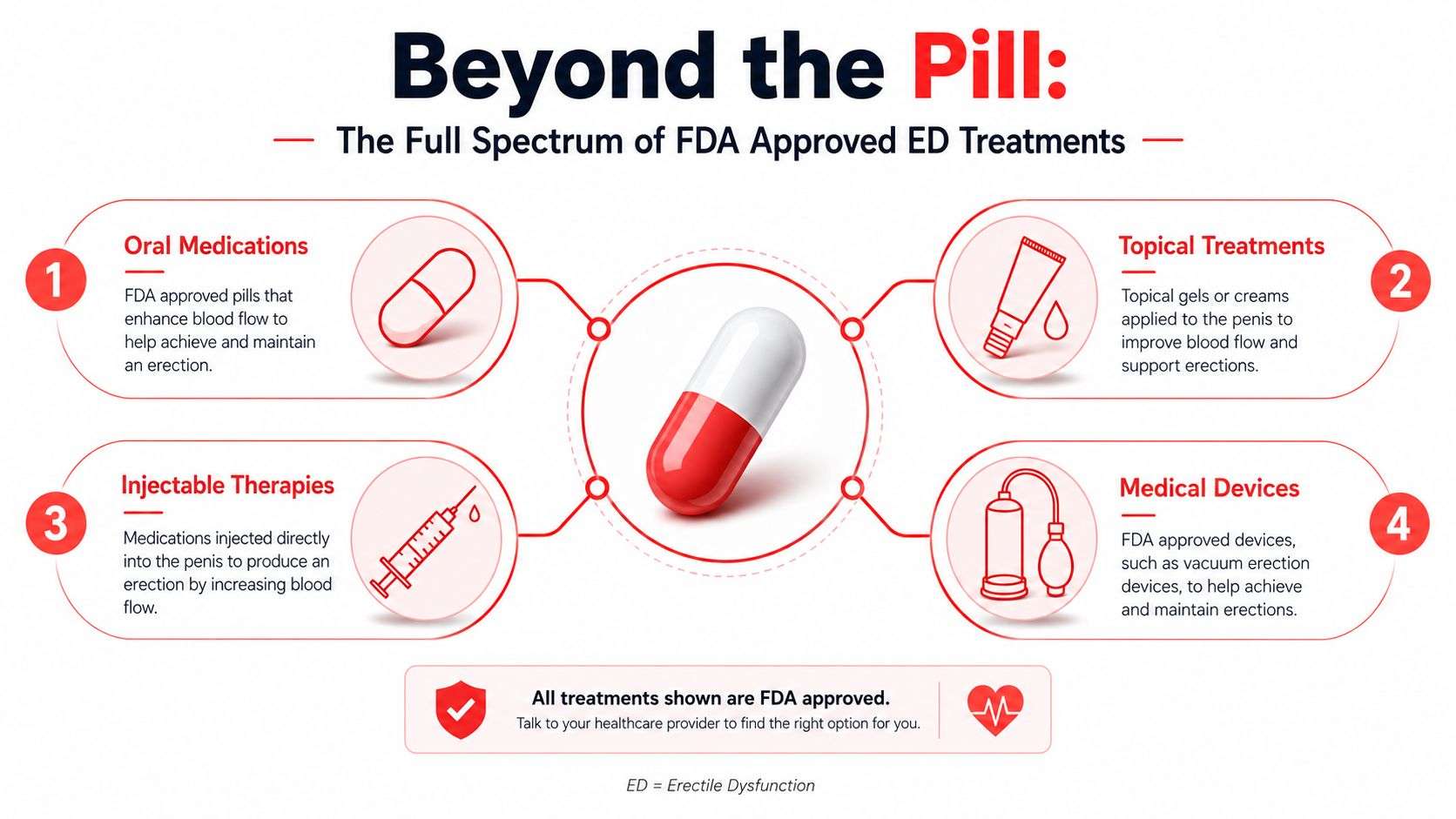
Most men still use the phrase FDA approved ED treatments to mean oral pills only. That shorthand misses the full picture. The approved options now include oral medications, topical treatment, injectable therapy, and medical devices or surgical options for men who need something beyond first-line pills.
Why the full ladder matters
The reason this matters is simple. PDE5 inhibitors remain the standard first-line pharmacologic option in major markets, but they are not the only approved path. The American Urological Association guidance summarized in the provided data shows these medications work well for many men, yet side effects and contraindications still limit use in some patients oral medication overview. That's exactly why the treatment conversation has to widen.
Practical rule: If a man can't take a pill safely, or a pill simply doesn't work well enough, that doesn't mean treatment is over. It means the next rung on the ladder needs to be considered.
The broader ladder includes alprostadil, the only FDA-approved injectable drug for ED in the U.S., which sits in second-line care alongside vacuum erection devices and penile prostheses Indian Health Service formulary guidance. The newer over-the-counter topical option, MED3000 (Eroxon), adds another non-pill choice to the conversation, especially for men who want discreet use or want to avoid prescription pills Harvard Health coverage.
What a useful ED conversation actually sounds like
A useful visit doesn't start with a brand name. It starts with questions about heart disease, nitrate use, diabetes, prior prostate surgery, side effects, and how much timing flexibility matters. That's because the best fda approved ed treatments are not chosen by popularity, they're chosen by fit.
For some men, that fit is a pill taken before sex. For others, it's a gel used at home without planning ahead. For others still, it's an injection or a device that bypasses the limitations of oral therapy. Once you see the full range, the treatment path becomes less frustrating and far more practical.
Understanding the Four FDA-Approved Oral PDE5 Inhibitors
The four FDA-approved oral PDE5 inhibitors used in U.S. practice are sildenafil, tadalafil, vardenafil, and avanafil AUA guideline PDF. They work through the same basic pathway, relaxing penile smooth muscle and increasing blood flow, but they do not behave the same way in real life. Timing, duration, and side effects shape the choice, and that is why one man may do well on one pill while another gets a poor fit from it.
| Medication | Onset Time | Duration | Common Side Effects |
|---|---|---|---|
| Sildenafil | About 30 to 60 minutes | Not specified in the provided data | Dyspepsia is reported in the provided data at a mean of 3.88% oral medication overview |
| Tadalafil | About 30 to 45 minutes | 24 to 36 hours AUA guideline PDF | Side effects are generally similar to the class profile, with the provided data emphasizing meaningful efficacy versus placebo rather than a single highlighted adverse effect oral medication overview |
| Vardenafil | About 30 to 60 minutes | Not specified in the provided data | Headache at a mean of 9.14% and flushing at a mean of 9.70% oral medication overview |
| Avanafil | 15 to 30 minutes AUA guideline PDF | Not specified in the provided data | Side effect profile is not quantified in the provided data |
What a useful ED conversation sounds like
A useful visit starts with fit, not branding. I want to know about heart disease, nitrate use, diabetes, prior prostate surgery, side effects, and how much timing flexibility matters, because those details change which FDA approved ED treatments make sense.
The practical trade-off is simple. Avanafil offers the fastest onset, which helps men who do not want a long wait before intimacy. Tadalafil gives the longest window, which reduces planning pressure and fits men who want more flexibility AUA guideline PDF. Sildenafil and vardenafil remain familiar options when a man wants a standard on-demand pill and is comfortable with a typical timing window.
The American Urological Association review also found clear improvement versus placebo, with mean post-treatment EDITS scores of 71.40 for sildenafil, 69.36 for tadalafil, 59.06 for vardenafil, and 47.27 for placebo across study arms oral medication overview. That does not mean every patient responds the same way, but it does explain why oral therapy became the first step for many men.
Clinical takeaway: If a patient wants the broadest timing window, tadalafil often fits best. If speed matters more, avanafil deserves discussion. If side effects are the main concern, the class still helps many men, but the choice should be individualized rather than assumed.
For a plain-language explanation of how these pills work, this guide on how erectile dysfunction treatment pills work is a useful companion.
Non-Oral FDA Approved ED Treatments and When to Use Them
Some men do better with a route that does not depend on swallowing a pill. Non-oral FDA-approved ED treatments matter most for men with diabetes, men after prostate surgery, and men who use nitrates or have other reasons to avoid PDE5 inhibitors Indian Health Service formulary guidance.
The main non-pill options
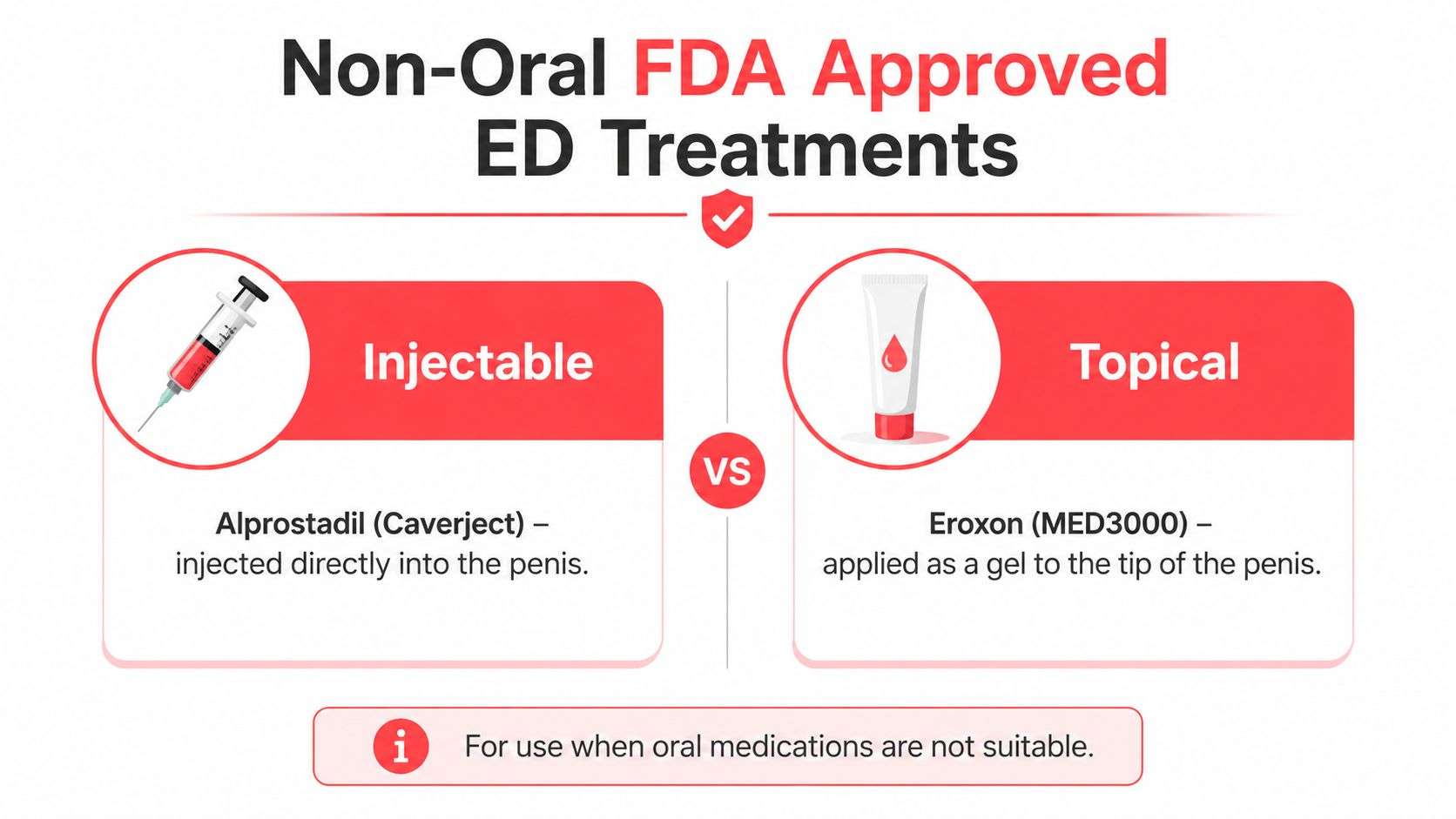
Alprostadil is the only FDA-approved injectable ED drug in the U.S. It is usually considered when oral medications fail, cause side effects, or cannot be used safely Indian Health Service formulary guidance. In the right patient, it can work very well, but it requires comfort with injection technique and acceptance of a more hands-on treatment process.
The newer topical option is the over-the-counter topical gel. Harvard Health reported that clinical trials found some men using it achieved an erection within a short window long enough for sex, with low rates of headache and nausea Harvard Health. That makes it a real access expansion, especially for men who want a non-prescription option and prefer to avoid needles.
Where devices and implants fit
Vacuum erection devices and penile prostheses still have a place in the treatment ladder, even though they get less attention than pills. Devices can help men who need a non-drug solution, while implants are usually reserved for severe or treatment-resistant ED. The point is not that one option beats the others, it is that each one fits a different clinical problem.
If a patient wants discretion, a topical option may feel easier than a pill or injection. If a patient wants predictability after multiple failures, an implant conversation may be more realistic than trying yet another oral medication.
For men comparing injectables more closely, this overview of erectile dysfunction shot treatments gives a practical look at the injection pathway. In clinic, the decision usually comes down to the same few issues, comfort with needles, urgency of treatment, and whether a temporary solution is enough or a longer-term answer is needed.
How to Choose the Right FDA Approved ED Treatment for Your Needs
The right choice starts with the patient, not the marketing. Heart disease, nitrate use, diabetes, past prostate surgery, and medication side effects can all change what is reasonable. One treatment may be a poor fit for one man and a strong fit for another, even when the symptom is the same.
Match the treatment to the goal
A man who values convenience often starts with oral PDE5 inhibitors because they are familiar, widely used, and easy to fit around sex. If fast action matters more than a long window, a newer topical gel may appeal because it does not require a prescription and has shown quick effect in trial settings.
If a man wants long-term results after less invasive options have not delivered enough, penile implants deserve a serious discussion. They are not the first step, but for severe or treatment-resistant ED they can be the most practical end point. If pills are not appropriate, injections or other non-oral approaches usually move higher on the list Indian Health Service formulary guidance.
The practical questions that matter most
Before choosing, I ask patients a few direct questions.
- Can I safely use a PDE5 inhibitor? If you take nitrates or have a cardiac reason to avoid them, that option may be off the table.
- Do I need spontaneity or a tight timing window? That question often separates tadalafil from other oral choices AUA guideline PDF.
- Am I willing to use a needle or a device? If not, that narrows the field quickly.
- Do I want a temporary fix or a more durable solution? That separates short-acting treatments from implants.
The best treatment is the one a patient will use safely and consistently, aligned with their health profile.
The Role of Regenerative Therapies in Modern ED Care
A lot of men ask about regenerative care because they want more than symptom management. They want tissue-level change, better responsiveness, and a path that doesn't feel like another temporary workaround. That curiosity is fair, but the regulatory categories matter just as much as the marketing language.
Approved, cleared, and investigational are not the same thing
FDA approved ED treatments still center on PDE5 inhibitors, alprostadil injections, and newer non-pill options like MED3000/Eroxon. Regenerative approaches such as acoustic wave therapy, laser therapy, and platelet-rich plasma are often discussed as promising or supportive, but they are not the same as an FDA-approved drug pathway. The distinction matters because a therapy used in a clinic is not automatically approved for ED.
A therapy can still be part of a real care plan without belonging to the approved drug ladder, and that is where honest counseling matters. Patients should know whether they are being offered a standard treatment, an adjunct, or an investigational service.
How these approaches fit in practice
In practice, regenerative therapies may be considered for men who want to address vascular health, tissue quality, or responsiveness in a broader way. They may also come up when men want to reduce dependence on repeated symptom-only treatment. The conversation should stay grounded, though. These approaches are not a substitute for a full evaluation, especially when diabetes, hormonal issues, vascular disease, or medication effects are in play.
For men comparing regenerative injection options, the discussion around PRP penis injections is usually less about chasing a dramatic outcome and more about whether the patient understands the evidence gap and the likely role of the treatment. That is the level of caution worth keeping.
Practical rule: If a regenerative option is being offered, ask whether it is being presented as FDA-approved treatment, adjunct care, or an investigational service. Those are very different promises.
The most useful care plans often combine a proven ED treatment with risk factor management and, in selected cases, regenerative adjuncts. That keeps expectations realistic and helps a man avoid spending time and money on a label instead of a result.
Accessing FDA Approved ED Treatments and Building a Care Plan
A lot of men don't get stuck on the decision. They get stuck on the logistics. They're not sure whether to start with a primary care clinician, a urologist, or a sexual health clinic. They're not sure how prescriptions, devices, follow-up visits, and insurance all fit together.
A common path starts with an evaluation in primary care. The clinician reviews symptoms, medication list, blood pressure, diabetes status, cardiovascular history, and any warning signs that point to a deeper cause. If the situation is straightforward, oral therapy may be started right away. If the case is more complex, referral to a urologist or sexual medicine practice makes sense.
For men in the Dallas-Fort Worth area, Sexual Wellness Centers of America is one clinic that provides erectile dysfunction evaluation and treatment planning alongside non-surgical regenerative services. That kind of setting can be useful when a man wants a structured plan, follow-up, and access to more than one treatment lane.
Insurance coverage is uneven across ED care. Some prescriptions are easier to fill than others, and devices or newer options may require more out-of-pocket spending. Finances shouldn't be ignored, because the most effective plan is still the one a patient can sustain.
The best next step is usually to ask three questions at the visit. What's safe for my health profile, what should I expect on day one, and what happens if the first option doesn't work? A care plan built around those answers is far more likely to hold up in real life.
Taking Control of Your Sexual Health with Confidence
ED is common, but it's not something men should normalize into silence. There are FDA approved ED treatments that work well for many patients, and there are solid alternatives when pills aren't the right fit. The key is to stop treating every case like the same case.
Oral PDE5 inhibitors still anchor first-line care because they're effective and familiar. Non-oral options matter because some men can't use pills safely, some don't respond well enough, and some want a different experience. Newer options like Eroxon have broadened access, while injections, devices, and implants remain important for men who need more than a tablet can offer.
Personalized care wins here. That means matching the treatment to the person, not forcing the person to adapt to the treatment. It also means getting a real medical evaluation instead of guessing, borrowing advice, or assuming the first failed attempt is the final answer.
If you're ready to move from uncertainty to a real plan, Sexual Wellness Centers of America offers erectile dysfunction evaluation, treatment planning, and non-surgical regenerative care in a clinic setting. Visit Sexual Wellness Centers of America to explore your options and schedule a consultation that fits your health, your goals, and your level of comfort.