
The Small Gland With an Outsized Role in Your Health
A pituitary lab panel is a group of blood (and sometimes urine or saliva) tests that measure the hormones produced by — or controlled by — your pituitary gland. Doctors use these tests to find out if your pituitary is making too much or too little of key hormones, and to identify the root cause of symptoms like fatigue, weight gain, low libido, or sexual dysfunction.
Here’s what a standard pituitary lab panel typically measures:
| Hormone | What It Signals |
|---|---|
| ACTH | Stress response and cortisol production |
| Cortisol | Adrenal gland function |
| TSH + Free T4 | Thyroid function |
| Prolactin | Reproductive health, possible tumor |
| IGF-1 / GH | Growth hormone activity |
| LH + FSH | Reproductive hormones, fertility |
| Testosterone / Estrogen | Sexual health and hormone balance |
Your pituitary gland is about the size of a pea — but it controls nearly every major hormone system in your body. When it misfires, the effects ripple outward: your thyroid slows down, your adrenal glands under-produce cortisol, your sex drive drops, and your energy disappears.
What makes this especially tricky is that pituitary problems are often invisible on the surface. Research shows pituitary adenomas (benign tumors) affect roughly 76–94 people per 100,000 — and an estimated 10–20% of people undergoing brain imaging for unrelated reasons turn out to have one without knowing it.
That means many people are walking around with a hormonal imbalance that has a clear, testable cause — they just haven’t been tested yet.
I’m Jeff Nuziard, CEO of Sexual Wellness Centers of America, and through years of helping patients in Colleyville, TX navigate hormone-related sexual health challenges, I’ve seen how a targeted pituitary lab panel can be the turning point that finally makes sense of years of unexplained symptoms. In this guide, we’ll break down exactly what each test measures, why it matters, and how to use the results to take back control of your health.
Understanding the Scope of a Pituitary Lab Panel
A pituitary lab panel is not one single universal test with one fixed recipe. It is a structured hormone workup built around the pituitary gland and the organs it controls: the thyroid, adrenal glands, ovaries, testes, and growth hormone axis.
That matters because pituitary disease can show up in two very different ways:
- Hormone hypersecretion, where a tumor makes too much hormone
- Hypopituitarism, where the gland makes too little because of compression, injury, surgery, radiation, or disease
This is why doctors do not look only for “high” results. Low or inappropriately normal values can be just as important. A non-secreting mass in the sellar region may still suppress normal pituitary tissue and create major symptoms.
Pituitary adenomas are fairly common as brain tumors go, and pituitary incidentalomas are found in about 10-20% of people who get brain imaging for unrelated reasons. So if symptoms suggest a pituitary issue, labs are often the first step, followed by MRI if needed. For a broader clinical overview, see Pituitary Function Tests Overview. If testing leads to treatment for hormone deficiency, our Hormone Replacement Therapy page explains how replacement is tailored.

The Anterior Pituitary Lab Panel: ACTH, TSH, and Prolactin
The anterior pituitary makes several of the hormones most often checked in a panel.
- ACTH tells the adrenal glands to make cortisol
- TSH tells the thyroid to make thyroid hormone
- Prolactin helps regulate lactation and can rise sharply with prolactin-secreting tumors
Prolactin is especially useful in pituitary tumor diagnosis. In a patient with a macroadenoma larger than 10 mm, a serum prolactin level above 200 mcg/L strongly supports prolactinoma. Lower elevations can still happen, but they may reflect the “stalk effect,” where a mass disrupts dopamine inhibition rather than actually producing prolactin itself.
TSH must always be read with free T4. A low free T4 with a low or inappropriately normal TSH suggests central, or secondary, hypothyroidism. In other words, the thyroid is not the original problem – the pituitary is.
ACTH is trickier because it is fragile and timing-sensitive. It is usually interpreted together with cortisol and often requires careful sample handling. If a pituitary tumor is suspected, a standard diagnostic pathway is summarized in Tests for Pituitary Tumors.
Growth Hormone vs. IGF-1 in a Pituitary Lab Panel
Growth hormone is famous for being unhelpful when measured randomly. That is not because the hormone does not matter. It is because GH is released in pulses, so a one-time blood draw may catch a peak, a valley, or basically nothing at all.
That is why IGF-1 is usually the better screening test for acromegaly. IGF-1 reflects integrated GH activity over time, which makes it much more stable and useful. In practical terms:
- Random GH can mislead
- IGF-1 gives a better average picture of growth hormone exposure over 24 hours
- An elevated IGF-1 is the preferred first clue that a GH-secreting pituitary adenoma may be present
If IGF-1 is high or borderline but symptoms strongly suggest acromegaly, doctors often move to confirmatory testing. A concise diagnostic summary is available at Pituitary Tumor Diagnosis.
Gonadotropins and Sexual Health
LH and FSH are the pituitary signals that help regulate testosterone, estrogen, ovulation, and sperm production. If these are low, or normal when they should be high, the issue may be secondary hypogonadism from pituitary dysfunction.
This is often where pituitary testing overlaps with sexual wellness in real life. Patients may come in focused on symptoms such as:
- Low libido
- Erectile dysfunction
- Irregular periods
- Infertility
- Low energy
- Loss of muscle mass
A pituitary pattern might look like low testosterone with low or normal LH and FSH, suggesting the testes are not being adequately stimulated. In women, low estradiol with low or normal gonadotropins can point toward central suppression as well.
We often remind patients that sex hormones do not operate alone. They sit downstream from the pituitary. If you want to understand how hormone balance affects intimacy and function, see How Can Hormone Replacement Therapy Improve Sexual Health?.
Decoding the Hormones: Functional vs. Non-Functional Adenomas
A functional pituitary adenoma actively secretes hormone. A non-functional adenoma does not secrete clinically meaningful hormone, but it can still cause trouble by pressing on normal tissue or nearby structures.
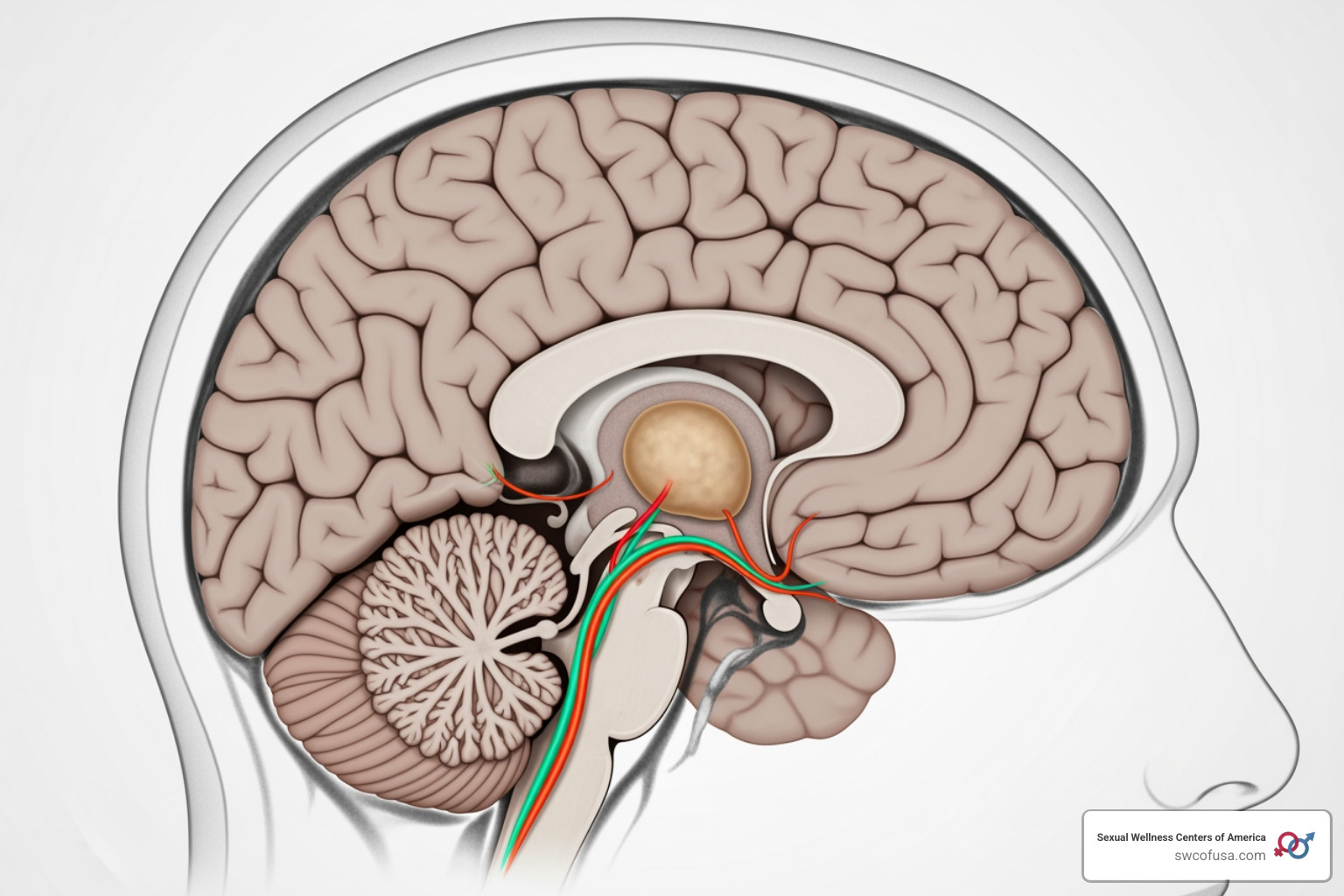
Doctors use lab patterns to help tell the difference.
Functional adenomas often produce a signature pattern such as:
- Very high prolactin in prolactinoma
- High IGF-1 in acromegaly
- Abnormal ACTH and cortisol tests in Cushing’s disease
- Rarely, TSH-driven hyperthyroidism
Non-functional adenomas may show the opposite pattern:
- Low testosterone or estradiol because LH/FSH are suppressed
- Low free T4 with inappropriately normal or low TSH
- Low morning cortisol if ACTH production is impaired
- Mild prolactin elevation from stalk effect rather than a true prolactinoma
Mass effect also matters. Larger adenomas can compress the optic chiasm and cause visual field defects, especially loss of peripheral vision. For the lab side of hypopituitarism evaluation, Hypopituitarism | Choose the Right Test is a useful clinical reference.
Distinguishing Cushing’s Disease from Cushing’s Syndrome
This distinction trips people up all the time, so here is the clean version:
- Cushing’s syndrome means excess cortisol from any cause
- Cushing’s disease means excess cortisol specifically caused by an ACTH-secreting pituitary tumor
The first step is usually proving that cortisol excess is really present. Common screening tests include:
- Late-night salivary cortisol
- 24-hour urinary free cortisol
- Low-dose dexamethasone suppression testing
Late-night salivary cortisol is useful because cortisol should be near its daily low point late at night. If it is still elevated, that is suspicious. Research shows late-night salivary cortisol has a clinical sensitivity around 80-90% for diagnosing Cushing’s syndrome.
Once hypercortisolism is confirmed, ACTH helps narrow the source:
- Low ACTH suggests an adrenal source
- Normal or high ACTH suggests a pituitary or ectopic source
Doctors may then use high-dose dexamethasone testing, CRH stimulation, MRI, and sometimes petrosal sinus sampling to separate pituitary from ectopic ACTH production.
Monitoring Secondary Conditions
Pituitary disorders do not just create one diagnosis. They can cause secondary problems that also need testing and follow-up.
Central hypothyroidism is diagnosed with:
- Low free T4
- Low or inappropriately normal TSH
Central adrenal insufficiency often starts with:
- An 8:00 AM serum cortisol
- Sometimes ACTH
- Follow-up stimulation testing if results are borderline
Diabetes insipidus can occur when posterior pituitary signaling for water balance is impaired. Clues include:
- Excessive urination
- Excessive thirst
- High serum sodium
- Dilute urine with low urine osmolality
These patients may need urine and serum osmolality testing, water deprivation testing, or copeptin-based evaluation. Hormone follow-up is also important after surgery, radiation, or when replacing deficient hormones. For readers interested in broader hormone balance, Everything You Need to Know About HRT for Women may be helpful.
Dynamic Testing: Suppression and Provocation Protocols
Some pituitary disorders cannot be diagnosed with a single resting blood draw. That is where dynamic testing comes in. These tests intentionally challenge the endocrine system to see how it responds.
Examples include:
- Dexamethasone suppression test
- Oral Glucose Tolerance Test (OGTT) for GH suppression
- Insulin Tolerance Test (ITT)
- ACTH stimulation testing
- Water deprivation testing
The Endocrine Testing Protocols: Hypothalamic Pituitary Adrenal Axis resource provides an excellent technical overview of these methods.
Why are they needed? Because endocrine disease is often about response, not just baseline level. A hormone that looks “normal” at rest may fail to suppress or fail to rise when challenged.
Confirming Acromegaly and Growth Hormone Excess
If IGF-1 suggests acromegaly, the classic confirmatory test is the OGTT. After the patient drinks a glucose solution, GH should suppress. If it does not, that supports growth hormone excess.
A commonly cited positive result is failure of GH to drop below 1 mcg/L after 50-100 g of glucose.
This test helps when:
- Symptoms fit acromegaly but random GH is confusing
- IGF-1 is elevated
- IGF-1 and GH appear discordant and clarification is needed
Biochemical confirmation matters because acromegaly often develops slowly. Patients may notice ring size changes, jaw changes, headaches, joint pain, sweating, sleep apnea, or insulin resistance long before diagnosis.
Water Deprivation and Copeptin Testing
For suspected diabetes insipidus, doctors need to determine whether the body is failing to make vasopressin or simply failing to respond to it.
Water deprivation testing looks at what happens when fluids are withheld under close supervision:
- In normal physiology, urine becomes concentrated
- In diabetes insipidus, urine stays inappropriately dilute
This test helps distinguish:
- Cranial, or central, DI from poor AVP release
- Nephrogenic DI from kidney resistance to AVP
- Primary polydipsia from excess water intake
Copeptin is increasingly useful because it is a more stable surrogate marker for AVP. In specialized settings, copeptin measured after hypertonic saline infusion may improve diagnostic accuracy over traditional methods.
Preparation, Genetic Panels, and Laboratory Limitations
Good pituitary testing is not just about which hormones we order. It is also about when and how the samples are collected.
Several preparation rules matter:
- Some panels require fasting, often 8-12 hours depending on the lab and tests ordered
- Morning cortisol is usually drawn around 8:00 AM because cortisol peaks early in the day
- Late-night salivary cortisol must be collected at the instructed late-night time, because timing is the whole point
- Biotin supplements may interfere with some immunoassays
- ACTH samples need careful handling because the hormone breaks down easily
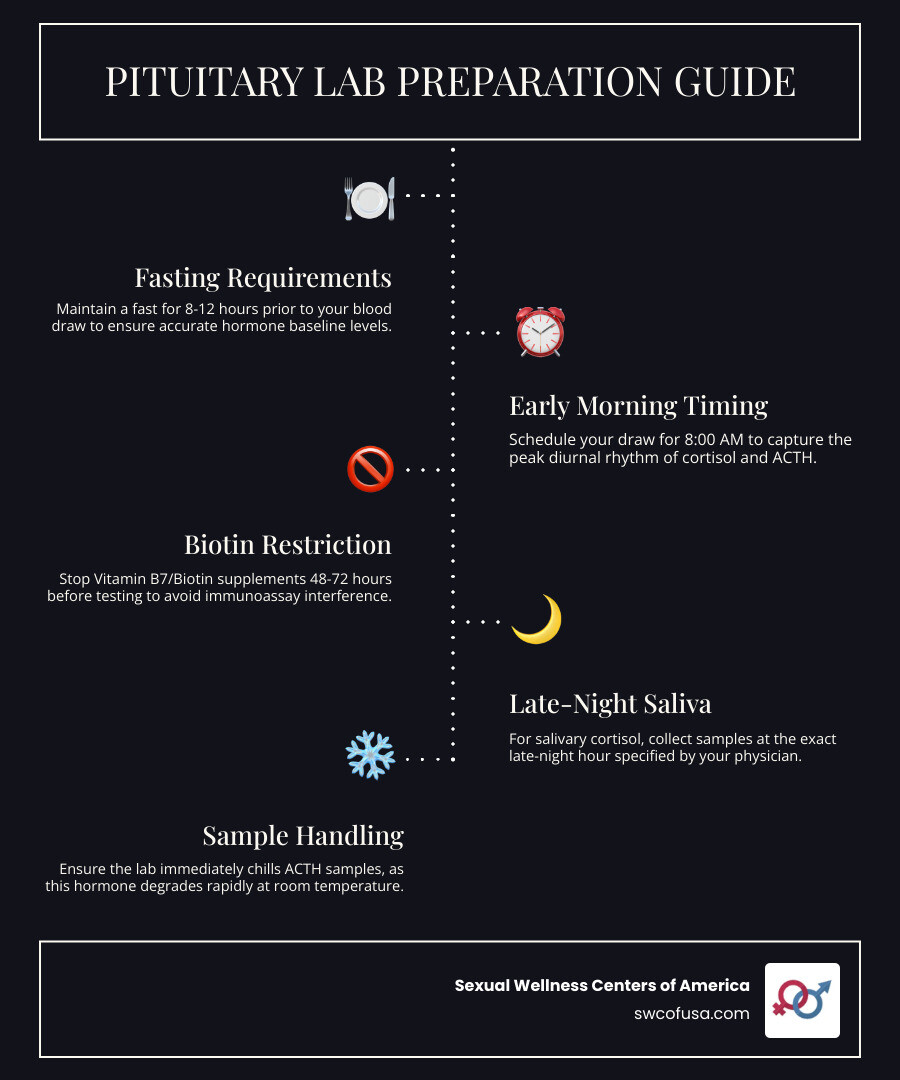
| Test or issue | Key preparation point |
|---|---|
| Morning cortisol/ACTH | Draw around 8:00 AM |
| Late-night salivary cortisol | Collect late at night exactly as instructed |
| General hormone panel | Fasting may be required by the lab |
| Biotin supplements | Often stop 7-10 days before testing if instructed |
| ACTH sample | Proper tube and rapid handling are important |
Timing is critical because cortisol follows a circadian rhythm, peaking around 8:00 AM and dropping toward a nighttime nadir. Draw it at the wrong time and the number may be technically accurate but clinically misleading. For patients thinking through broader hormone care, What to Consider Before Hormone Replacement Therapy is a practical next read.
The Hook Effect and False Negatives
One of the most important lab limitations in pituitary medicine is the hook effect.
This happens in some immunoassays when the hormone level is extremely high. Instead of reading as sky-high, the test can paradoxically read falsely low because excess antigen overwhelms the assay system. In real life, this matters most with large prolactin-secreting tumors.
So if a patient has a big pituitary mass but only a modest prolactin level, doctors may ask the lab to perform serial dilutions. That can uncover the true value and prevent a prolactinoma from being mistaken for a non-functional macroadenoma.
Other pitfalls include:
- Heterophilic antibodies causing false results
- Assay-to-assay variability
- Medication effects, including steroid therapy and estrogen
- Biotin interference with certain lab platforms
This is one reason specialist interpretation matters. Hormone results are not fortune cookies. They need context.
Genetic Screening and Petrosal Sinus Sampling
A genetic panel is not routine for every patient with a pituitary issue, but it can be very useful in selected cases.
Combined pituitary hormone deficiency panels may be considered when there is:
- Childhood-onset hormone deficiency
- Multiple pituitary hormone deficits
- Congenital findings
- Strong family history
- Concern for inherited syndromes
Genes commonly included in these panels may involve factors such as PROP1 and POU1F1, along with several other developmental pituitary genes.
Inferior Petrosal Sinus Sampling, or IPSS, is a very different tool. It is not a screening test. It is a specialized procedure used when Cushing’s workup remains unclear after blood tests and MRI.
In IPSS, blood is sampled from veins that drain the pituitary and compared with peripheral blood. If ACTH is much higher near the pituitary, that supports a pituitary source. If not, doctors may suspect ectopic ACTH production elsewhere.
IPSS is especially helpful when:
- MRI is normal or inconclusive
- A tiny pituitary lesion may be incidental rather than causal
- Standard testing cannot confidently distinguish pituitary from ectopic ACTH source
Frequently Asked Questions about Pituitary Testing
Why is the timing of my blood draw so critical?
Because some hormones change dramatically over the day. Cortisol is the best example: it normally peaks around 8:00 AM and falls late at night. ACTH also varies and is fragile in the tube. If we draw these at the wrong time, interpretation can be off. Timing is not a fussy detail – it is part of the test itself.
What is the difference between a functional and non-functional tumor?
A functional tumor actively secretes hormone and causes an excess state, like prolactinoma, acromegaly, or Cushing’s disease. A non-functional tumor does not secrete meaningful hormone, but it can still compress normal pituitary tissue and cause hormone deficiencies, headaches, or vision problems. So “non-functional” does not mean harmless.
How does biotin affect my pituitary lab results?
Biotin, also called vitamin B7, can interfere with certain immunoassay-based lab tests and create falsely high or falsely low results depending on the assay design. That is why many specialists recommend stopping high-dose biotin supplements before testing, often for about 7-10 days if your clinician or lab instructs you to do so.
Conclusion
A pituitary lab panel is one of the most useful ways to connect vague symptoms with a real biological cause. It can help identify hormone-secreting tumors, reveal hidden hormone deficiencies, guide MRI decisions, and monitor conditions such as central hypothyroidism, adrenal insufficiency, and diabetes insipidus.
At Sexual Wellness Centers of America in Colleyville, TX, we know that low libido, erectile dysfunction, fatigue, and poor performance are not always “just aging.” Sometimes the signal starts higher up the chain – right at the pituitary. Our personalized hormone and vitamin panels help us look deeper, so patients get answers instead of guesswork.
When hormone imbalance is part of the picture, our care model may also include advanced sexual wellness therapies such as HEshot®™, SHEshot®™, and regenMAX® technology, with a reported 97.2% efficacy in erectile dysfunction reversal. If you are ready to explore a more personalized path, learn more about Hormone Replacement Therapy Colleyville TX.
In short: your pituitary may be tiny, but it does not do tiny jobs. If your body feels off, testing the “master gland” can be the smartest next move.