
Understanding the Hidden Risks of Dorsogluteal Injections
Why is dorsal gluteal site is dangerous for im injection has become a critical question in modern healthcare as mounting evidence reveals serious safety concerns with this traditionally popular injection site.
Key Dangers of the Dorsogluteal Site:
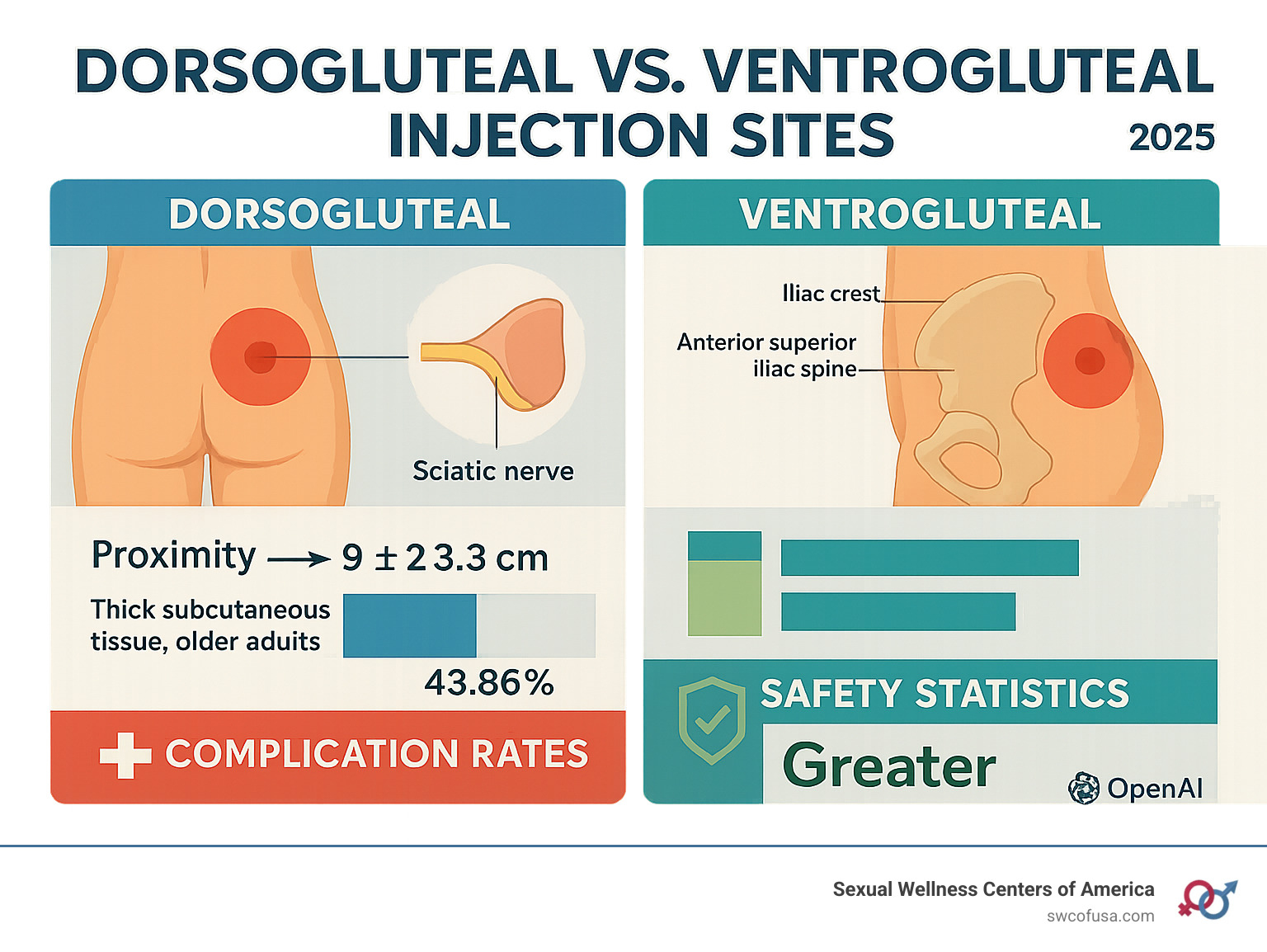
- Sciatic nerve proximity – Only 9±2.3 cm away, risking permanent nerve damage
- Thick subcutaneous tissue – 43.86% failure rate in older adults using standard needles
- Superior gluteal nerve and artery proximity – Risk of vascular and nerve injury
- Higher complication rates – Significantly more pain, bleeding, and hematoma formation
- Bone contact risk – 16.37% chance of needle hitting bone with standard length
For decades, healthcare providers relied on the dorsogluteal site for intramuscular injections, viewing it as the go-to location due to its perceived large muscle mass. However, recent research has dramatically shifted this perspective. Studies now show that the ventrogluteal site offers significantly better safety outcomes, with lower risks of nerve damage, reduced pain levels, and improved medication delivery success rates.
The evidence is clear: what was once considered standard practice may actually put patients at unnecessary risk. Understanding these dangers empowers both healthcare providers and patients to make informed decisions about injection site selection.
As Jeff Nuziard, CEO of Sexual Wellness Centers of America, I’ve witnessed the importance of understanding why is dorsal gluteal site is dangerous for im injection when providing hormone therapies and other injectable treatments to our patients. My experience in healthcare innovation has shown me that evidence-based practices must always take precedence over traditional methods, especially when patient safety is at stake.
Why is the Dorsogluteal Site Dangerous for IM Injection? A Look at the Anatomy
When we administer an intramuscular (IM) injection, our goal is to deliver medication deep into the muscle tissue, where it can be absorbed effectively. However, the human body is a complex network of nerves, blood vessels, and varying tissue layers. The dorsogluteal site, located in the upper outer quadrant of the buttock, presents several anatomical risks that make it a less-than-ideal choice for IM injections.
The primary concern, and indeed a major reason why is dorsal gluteal site is dangerous for im injection, lies in its close proximity to vital structures. This area is a busy neighborhood for important anatomical features, including the sciatic nerve, the superior gluteal nerve, and the superior gluteal artery. Accidentally striking any of these can lead to serious, and sometimes permanent, injury.
Imagine trying to hit a small target in a dark room filled with delicate, expensive glassware. That’s a bit like injecting into the dorsogluteal site without precise knowledge and technique. Even with careful landmarking, the variability in human anatomy means that what’s safe for one person might not be for another. This inherent unpredictability increases the potential for adverse events, from nerve damage to localized bleeding and discomfort.
The Sciatic Nerve: A Major Reason Why the Dorsogluteal Site is Dangerous for IM Injection
The sciatic nerve is the largest single nerve in the human body, running from the lower back down through the buttock and leg. It’s responsible for motor function and sensation in a significant portion of the lower limb. Its course through the gluteal region makes it incredibly vulnerable during dorsogluteal injections. Research shows the mean distance from the dorsogluteal site to the sciatic nerve is a mere 9±2.3 cm. In contrast, the safer ventrogluteal site boasts a mean distance of 18±3.5 cm, providing a much wider margin for error.
Accidental injury to the sciatic nerve during an IM injection can lead to a range of debilitating symptoms, collectively known as sciatic nerve injury or traumatic injection neuropathy. These can include:
- Foot drop: A condition where the patient struggles to lift the front part of their foot, causing the toes to drag while walking. This is a common and often permanent consequence.
- Sensory loss: Numbness or reduced sensation in parts of the leg and foot.
- Paresthesias: Tingling, burning, or “pins and needles” sensations.
- Paralysis: In severe cases, complete loss of muscle function in areas supplied by the nerve.
- Chronic pain: Persistent and often severe neuropathic pain that can significantly impact a patient’s quality of life.
The issue of sciatic nerve injury from IM injections is not a new one; it’s been documented since the late 19th century. Yet, it remains a global problem. For instance, in Pakistan, the estimated annual incidence of traumatic injection neuropathy involving the sciatic nerve was tragically thought to be around six million children between 2001 and 2003. This highlights the widespread nature and devastating impact of this preventable complication.
For more detailed information on this topic, you can refer to Scientific research on sciatic nerve injury from injections.
Subcutaneous Tissue vs. Muscle: Why the Dorsogluteal Site is Dangerous for IM Injection Efficacy
Beyond the risk of nerve damage, another significant factor contributing to why is dorsal gluteal site is dangerous for im injection relates to the thickness of the subcutaneous (fat) tissue layer. For an IM injection to be effective, the medication must reach the muscle. If it’s inadvertently injected into the subcutaneous fat layer, several problems can arise:
- Injection Failure: The medication doesn’t reach its intended target. Studies have shown alarming rates of injection failure at the dorsogluteal site. For older adults using a standard 1¼ inch (32 mm) needle, the rate of drug delivery to the subcutaneous tissue (instead of muscle) was a staggering 43.86% for the dorsogluteal site, compared to 15.20% for the ventrogluteal site. Another study found that 38% of dorsogluteal IM injections failed because the drug was administered to the subcutaneous tissue. This means nearly half the time, the injection might not be doing what it’s supposed to!
- Medication Absorption: Medication absorbed from fat tissue is typically much slower and less predictable than from muscle. This can lead to reduced efficacy, meaning the patient might not get the full therapeutic benefit of the drug, or the onset of action could be significantly delayed.
- Risk of Abscess and Granulomas: Injecting irritating medications into the subcutaneous tissue can cause localized reactions, including pain, inflammation, and the formation of sterile abscesses or calcified granulomas. One study found that 152 out of 160 calcified granulomas identified via CT-scan were in the subcutaneous adipose tissue and caused after dorsogluteal injection. Similarly, 39 out of 42 abscesses operated on in the gluteal area were due to intramuscular injections in the dorsogluteal site. These complications can be painful, require further medical intervention, and even necessitate surgical drainage.
The thick subcutaneous tissue at the dorsogluteal site acts like a cushion, often preventing the needle from reaching the muscle. This not only compromises the effectiveness of the medication but also increases the risk of local tissue damage and discomfort.
For more information on intramuscular injections, including the importance of proper technique, visit our page on More info about IM Injections.
The Safer Alternative: Comparing the Dorsogluteal and Ventrogluteal Sites
The good news is that we don’t have to accept the risks that come with dorsogluteal injections. Healthcare professionals worldwide are making a smart shift toward the ventrogluteal site as the preferred choice for gluteal intramuscular injections. This isn’t just following a trend – it’s following the science.
Think of the ventrogluteal site as nature’s purpose-built injection zone. Located on the side of your hip, this area is formed by the gluteus medius and minimus muscles, which are both thick and well-supplied with blood flow. Here’s what makes it special: it’s essentially a “no-fly zone” for major nerves and blood vessels. The sciatic nerve, which causes so much trouble at the dorsogluteal site, runs far away from this area.
But the anatomical advantages don’t stop there. The ventrogluteal site typically has a thinner layer of fat under the skin and thicker muscle mass compared to the dorsogluteal site. This means your medication is much more likely to actually reach the muscle where it belongs, leading to better absorption and more predictable results. Plus, patients consistently report less pain and discomfort with ventrogluteal injections.
The evidence speaks for itself when we look at the key safety differences:
| Metric | Dorsogluteal Site (DS) | Ventrogluteal Site (VS) |
|---|---|---|
| Nerve Proximity | Close to sciatic nerve (avg. 9±2.3 cm) | Far from sciatic nerve (avg. 18±3.5 cm) |
| Subcutaneous Fat | Thicker (avg. 22.97 ± 7.40 mm) | Thinner (avg. 20.07 ± 6.64 mm) |
| Muscle Thickness | Thinner (avg. 25.61 ± 4.30 mm) | Thicker (avg. 40.13 ± 5.59 mm) |
| Risk of Bone Contact | 16.37% (with standard 32mm needle) | 0% (with standard 32mm needle) |
| Reported Pain | Higher (significant relation to more pain) | Lower (significant relation to less pain, SMD = -0.63) |
| Bleeding | Higher (significant relation to more bleeding) | Lower (significant relation to less bleeding, SMD = -3.46) |
| Hematoma | Higher (significant relation to more hematoma) | Lower (significant relation to less hematoma) |
| Subcutaneous Inj. | Higher rate of accidental subcutaneous injection (43.86%) | Lower rate of accidental subcutaneous injection (15.20%) |
Evidence for the Ventrogluteal Site’s Superiority
When researchers combined data from 17 different studies involving 1,429 patients, the results were crystal clear. The ventrogluteal site consistently outperformed the dorsogluteal site across multiple important measures.
Pain reduction was one of the most significant findings. Patients receiving ventrogluteal injections experienced notably less discomfort, which matters enormously when you’re getting regular treatments. Nobody wants their healthcare to hurt more than necessary.
Less bleeding and bruising were also major advantages. The ventrogluteal site showed significantly less bleeding overall, and patients developed fewer hematomas (those unsightly bruises) both 48 and 72 hours after their injection. This means faster healing and less visible evidence that you’ve had an injection.
The anatomical benefits we mentioned earlier – thinner fat layer and thicker muscle – were confirmed across multiple studies. This combination makes it much easier to ensure your medication reaches the right spot and gets absorbed properly.
While some studies show that very obese patients might still face challenges with medication reaching the muscle (which we’ll discuss in the next section), the overall safety profile of the ventrogluteal site makes it the clear winner. When you consider that understanding why is dorsal gluteal site is dangerous for im injection has led to this evidence-based alternative, the choice becomes obvious.
For more detailed information about gluteal muscle injections, you can explore our resource on IM Injection Gluteal Muscle. The comprehensive research supporting these findings is available in this important study: Adverse effects of dorsogluteal versus ventrogluteal injection: A meta-analysis.
How to Locate the Ventrogluteal Site Correctly
One reason some healthcare providers still use the dorsogluteal site is simple unfamiliarity with finding the ventrogluteal location. But here’s the thing – once you learn the technique, it’s actually more reliable and consistent than the older method.
The “V-finger” method is surprisingly straightforward. Your healthcare provider will have you lie on your side with your hip and knee slightly bent to relax the muscles. They’ll then place their palm on the bony bump at the top of your thigh bone (called the greater trochanter) – this is easy to feel through the skin.
Next comes the clever part. Using the same hand, they’ll place their index finger on the front hip bone (the anterior superior iliac spine) and stretch their middle finger back along the top of the hip bone as far as comfortable. This creates a natural “V” shape between their fingers.
The center of that “V” is your injection site – right over the thick, safe gluteus medius and minimus muscles. It’s like having built-in anatomical landmarks that guide you to exactly the right spot every time.

What makes this method so reliable is that it uses bony landmarks that don’t change from person to person. Unlike trying to estimate “upper outer quadrant” areas, these hip bones provide consistent, palpable guides that lead to the safest injection zone. The injection then goes straight into the center of the “V” at a 90-degree angle.
At Sexual Wellness Centers of America, we prioritize using the safest, most effective injection techniques for all our treatments, whether we’re administering HEshot®™, SHEshot®™, or other injectable therapies. Understanding proper injection site selection is just one way we ensure our patients receive the highest quality care.
Special Considerations for Different Patient Populations
Understanding why is dorsal gluteal site is dangerous for im injection becomes even more critical when we consider that every patient is unique. Body Mass Index (BMI), age-related changes, muscle mass variations, and subcutaneous fat distribution all play crucial roles in injection safety and effectiveness.
Think of it this way: what works perfectly for a 25-year-old athlete might not be the best approach for a 70-year-old grandmother or someone carrying extra weight. Our bodies change throughout our lives, and our injection techniques need to adapt accordingly.
At Sexual Wellness Centers of America, we see this diversity daily in our patients seeking hormone therapies and other injectable treatments. Each person deserves an individualized approach that takes their specific anatomy into account.
Older Adults and Injection Site Choice
As we age, our bodies naturally undergo changes that can significantly impact injection safety. Muscle mass tends to decrease while subcutaneous fat often increases – a double challenge that makes proper site selection even more important.
For older adults, the dangers of the dorsogluteal site become magnified. With less muscle tissue to work with and more fat to penetrate, a standard needle faces much higher odds of missing its target entirely.
The statistics are eye-opening: older adults receiving dorsogluteal injections with standard needles have a 43.86% risk of the medication ending up in fat tissue instead of muscle. Compare that to the ventrogluteal site’s much lower 15.20% failure rate, and the choice becomes clear.
But there’s another serious concern – bone contact. When muscle tissue thins with age, there’s a real risk that the needle will hit bone, causing painful contusions or even tissue death. The dorsogluteal site carries a 16.37% risk of bone penetration with standard needles, while the ventrogluteal site shows zero risk of this complication.
These aren’t just numbers – they represent real people experiencing unnecessary pain and complications that could have been avoided with better site selection.
Obesity and Injection Challenges
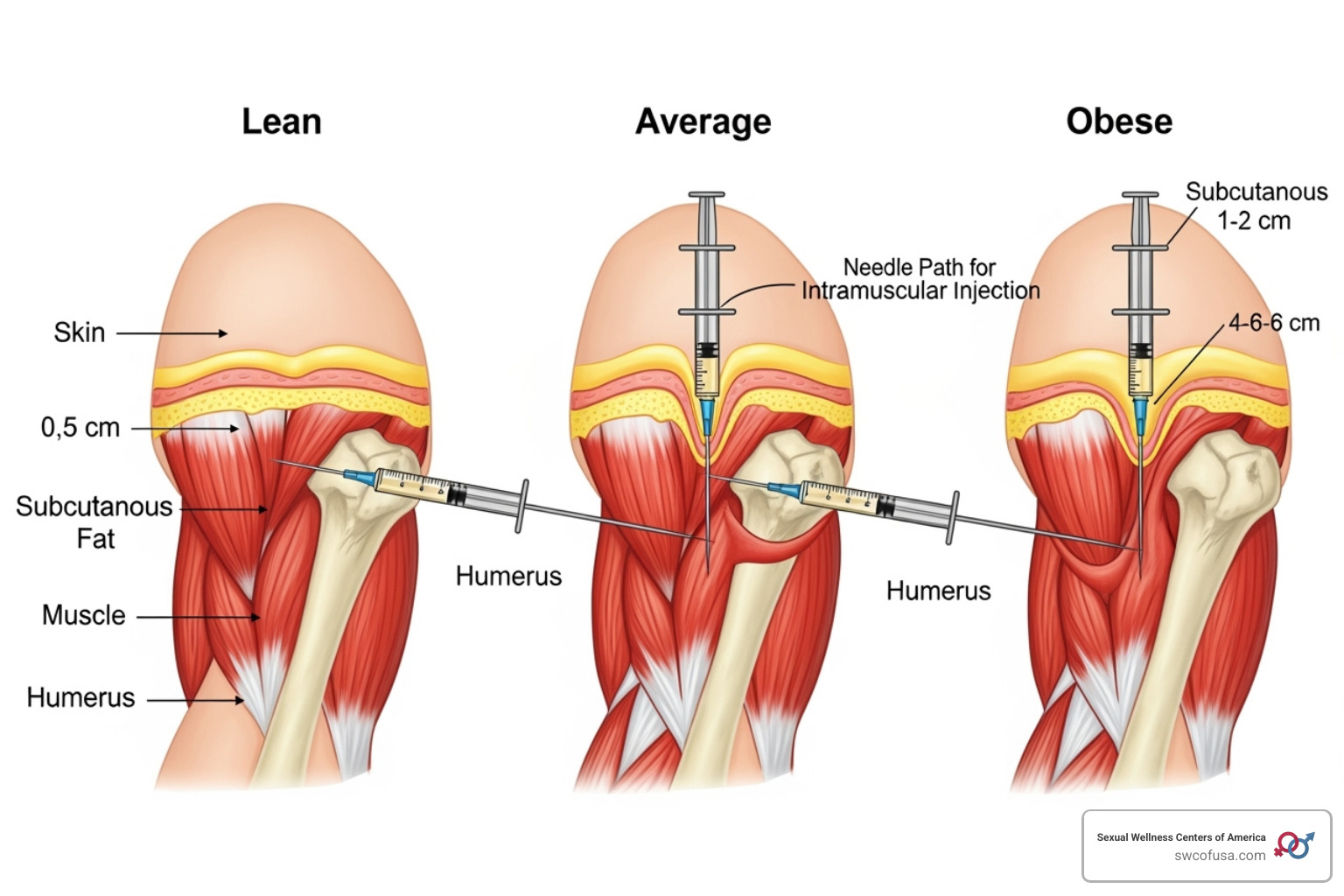
Patients with higher BMIs face their own unique set of injection challenges. The primary issue is increased subcutaneous fat thickness, which acts like a barrier between the needle and the muscle tissue underneath.
Standard needles that work fine for average-weight patients often fall short – literally – when trying to reach muscle through thicker fat layers. This is where needle length becomes crucial. Many obese patients need longer needles, sometimes up to 2 inches, to ensure the medication actually reaches the muscle.
Even with longer needles, the risk of failed intramuscular delivery remains a concern. However, the ventrogluteal site maintains its advantage because it typically has thicker muscle mass and more consistent anatomical landmarks, making successful injection more likely.
The beauty of the ventrogluteal site is that it adapts better to different body types. While obesity certainly presents challenges regardless of injection site, the ventrogluteal location’s superior anatomy gives both patients and healthcare providers a better chance of success.
Whether we’re administering HEshot®™, SHEshot®™, or other treatments, we carefully assess each patient’s individual anatomy and adjust our technique accordingly. Sometimes that means using different needle lengths, sometimes it means taking extra time to properly locate landmarks, but it always means putting patient safety first.
For more information on gluteal injection sites, including the gluteus maximus, you can read our detailed guide: More info about Gluteus Maximus IM Injection Site.
Frequently Asked Questions about Gluteal Injections
When patients come to Sexual Wellness Centers of America for treatments like HEshot®™ or SHEshot®™, they often have questions about injection techniques and safety. These are some of the most important questions we hear about gluteal injections.
Why was the dorsogluteal site ever popular?
It’s a fair question – if the dorsogluteal site is so risky, why did healthcare providers use it for so long? The answer lies in how medical knowledge evolves over time.
Historically, the dorsogluteal site seemed like the obvious choice. Healthcare educators taught it in nursing and medical schools for decades because the buttock appeared to have a large, easily accessible muscle mass. It looked safe and straightforward from the outside.
Familiarity played a huge role too. Older practitioners learned this technique during their training and became comfortable with it. When you’ve successfully given thousands of injections using one method, it’s natural to stick with what you know.
The real game-changer came with modern imaging studies. Before we had ultrasound and advanced anatomical research, we simply couldn’t see what was happening beneath the skin. We didn’t fully understand how close the sciatic nerve really was, or how thick the fat layer could be in different patients.
It’s actually a perfect example of evidence-based medicine in action. As our understanding improved, so did our practices. What seemed safe decades ago has been replaced by something much better.
Can a dorsogluteal injection cause permanent damage?
Unfortunately, yes – dorsogluteal injections can cause permanent, life-changing damage. This is one of the most serious reasons why is dorsal gluteal site is dangerous for im injection.
Direct injury to the sciatic nerve is the biggest concern. When a needle strikes this major nerve or injects medication too close to it, the results can be devastating. Patients may develop permanent foot drop, where they can’t lift the front part of their foot properly. Imagine having to drag your toes when you walk for the rest of your life.
Sensory loss is another common permanent effect. Some patients lose feeling in parts of their leg and foot forever. Others develop chronic neuropathic pain – a burning, shooting type of pain that’s incredibly difficult to treat and can severely impact quality of life.
In the most severe cases, patients experience paralysis in the affected leg muscles. This isn’t just temporary weakness – it’s permanent loss of function.
Vascular damage can also occur. The superior gluteal artery runs through this area, and puncturing it can cause serious bleeding and tissue damage. We’ve also seen patients develop painful abscesses and granulomas (hard lumps) that require surgical removal.
These aren’t rare, theoretical complications – they happen to real people. That’s why we take injection site selection so seriously at our centers.
Are there other safe IM injection sites besides the glutes?
Absolutely! While we prefer the ventrogluteal site for gluteal injections, there are several other excellent options depending on your specific needs.
The deltoid muscle in your upper arm is probably the most familiar to most people – it’s where you get your flu shot. This site works beautifully for smaller volume injections and has excellent blood supply for quick absorption. However, the muscle is smaller, so we typically limit injections here to 1-2 mL.
The vastus lateralis muscle in your thigh is another fantastic option. Located on the outer side of your thigh, this large, well-developed muscle can handle bigger volume injections (up to 3-5 mL). It’s especially popular for children and infants because it’s far from major nerves and blood vessels.
The choice of injection site depends on several factors: how much medication you need, your age and muscle mass, and what specific treatment you’re receiving. For our hormone therapies and sexual wellness treatments, we carefully evaluate each patient to determine the safest, most effective approach.
At Sexual Wellness Centers of America, we believe every patient deserves to know their options. Whether you’re receiving one of our specialized treatments or any other injectable medication, don’t hesitate to ask your healthcare provider about the safest injection site for your situation.
For more detailed information about thigh injections, you can visit: More info about IM Shot in Thigh.
The Final Verdict: Prioritizing Safety in IM Injections
The overwhelming evidence leaves no room for doubt: why is dorsal gluteal site is dangerous for im injection isn’t just an academic question anymore—it’s a patient safety imperative that demands immediate action from healthcare providers everywhere.
The dorsogluteal site carries unacceptable risks that we simply cannot ignore. With the sciatic nerve lurking just 9 centimeters away, a 43.86% failure rate in older adults, and documented cases of permanent nerve damage, continuing to use this site feels a bit like playing Russian roulette with our patients’ well-being. The superior gluteal nerve and artery add even more danger to an already risky situation.
The ventrogluteal site emerges as the clear winner in every meaningful safety metric. It’s not just slightly better—it’s dramatically safer. The 18-centimeter distance from the sciatic nerve, zero risk of bone contact with standard needles, and significantly lower rates of pain and bleeding make this the obvious choice for any healthcare provider who truly prioritizes patient safety.
At Sexual Wellness Centers of America, this evidence-based approach shapes everything we do. Whether we’re administering HEshot®™ or SHEshot®™ treatments, or utilizing our regenMAX® technology, we never compromise on safety. Proper injection technique isn’t just about following protocols—it’s about respecting the trust our patients place in us every time they walk through our doors.
Patient advocacy means more than just providing excellent care; it means empowering people with knowledge. When patients understand the risks and benefits of different injection sites, they become active participants in their healthcare decisions. This partnership between provider and patient creates better outcomes for everyone involved.
The transition from dorsogluteal to ventrogluteal isn’t just a trend—it’s the future of safe injection practices. Healthcare evolves, and we must evolve with it. Clinging to outdated methods because “that’s how we’ve always done it” puts patients at unnecessary risk and undermines the very foundation of medical ethics: first, do no harm.
The choice becomes crystal clear. The evidence supports the ventrogluteal site, patients benefit from reduced complications, and healthcare providers can feel confident they’re using the safest possible technique. It’s a win-win-win situation that makes the decision almost effortless.
Ready to experience the difference that evidence-based, safety-first injection practices can make in your wellness journey? Get more information on safe and effective IM Injections in Colleyville, TX and find how Sexual Wellness Centers of America combines cutting-edge safety protocols with personalized care to help you achieve your health goals.