
Understanding Medicare Coverage for Men’s Sexual Health
Is Peyronie’s disease treatment covered by Medicare? Yes, Medicare does cover medically necessary treatments for Peyronie’s disease, but coverage varies by treatment type and specific eligibility criteria.
Quick Coverage Summary:
- Medicare Part B: Covers 80% of Xiaflex injections after deductible (requires >30° curvature)
- Surgical treatments: Covered when deemed medically necessary after failed conservative therapy
- Diagnostic tests: Penile Doppler ultrasound and office visits covered under Part B
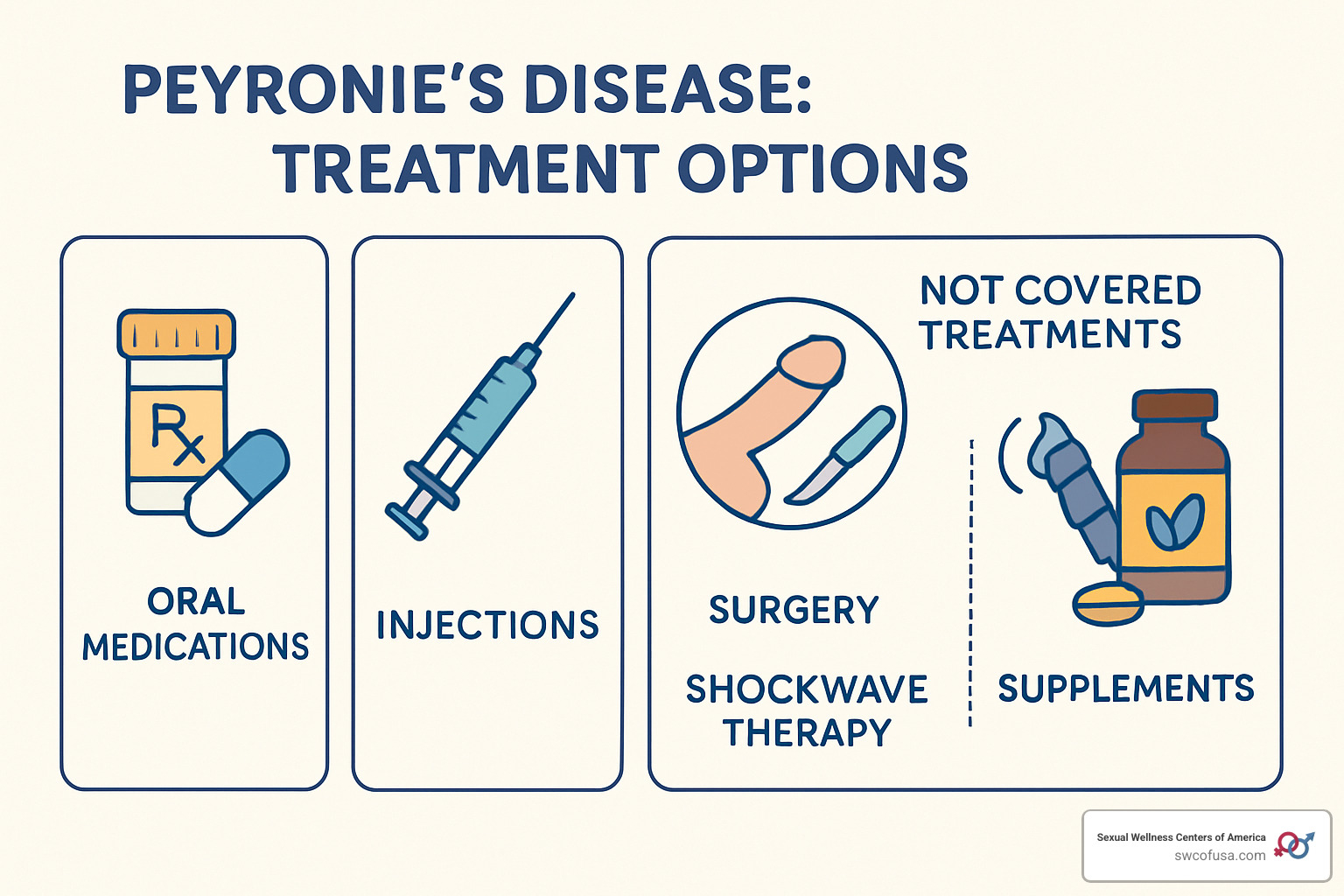
- What’s NOT covered: Shockwave therapy, experimental treatments, most oral medications
- Patient responsibility: 20% coinsurance plus annual deductible ($203 in 2021)
Peyronie’s disease affects an estimated 3-13% of men, causing painful penile curvature due to scar tissue buildup. Medicare recognizes this as a significant medical problem, which is why it covers evaluation and treatment when specific criteria are met.
Treatment costs can range from $20,000-$34,000 for Xiaflex injections to $13,000-$41,000 for surgical procedures. Most Medicare patients pay significantly less thanks to the 80% coverage rate.
Is peyronie’s disease treatment covered by medicare terms at a glance:
- does insurance cover treatment for peyronie’s disease
- over the counter treatment for peyronie’s disease
What Is Peyronie’s Disease & Why Treatment Matters
Peyronie’s disease occurs when fibrous scar tissue (plaques) forms inside your penis, causing abnormal curvature during erections. These plaques develop in the tunica albuginea, the tough outer layer surrounding the erectile chambers.
Common symptoms include:
- Curve greater than 30 degrees during erection
- Lumps or hard spots along the shaft
- Pain during erections (early stages)
- Penis shortening or hourglass shape
- Erectile dysfunction (affects about half of men)
Scientific research on prevalence and management shows that Peyronie’s disease affects between 3-13% of men, though some studies suggest rates as high as 20%.
Peyronie’s disease has two distinct phases:
The acute phase lasts 5-18 months with active inflammation, progressive curvature, and often painful erections. This represents the best window for non-surgical treatments.
The chronic phase begins when the condition stabilizes – curvature stops changing and pain typically decreases. Most surgical treatments occur during this phase after 3-6 months of stability.
Common Treatment Categories
Oral medications like vitamin E and colchicine show limited effectiveness and Medicare rarely covers them for Peyronie’s disease.
Penile traction devices apply gentle stretching over several hours daily and may help reduce curvature when used consistently.
Xiaflex® injections contain collagenase clostridium histolyticum, which breaks down collagen in penile plaques. This is the only FDA-approved injectable treatment.
Surgical options include penile plication (shortening the longer side) or plaque excision with grafting (lengthening the shorter side).
Penile implants address both curvature and erectile dysfunction in one procedure when both conditions are present.
Is Peyronie’s Disease Treatment Covered by Medicare?
Yes, Medicare does cover Peyronie’s disease treatment when specific medical criteria are met. Medicare recognizes this as a legitimate medical condition requiring treatment, not just a cosmetic issue.
Coverage is based on Medicare’s National Coverage Determination (NCD) 230.4 for impotence treatments. The CMS coverage determination outlines exact documentation requirements.
Medicare covers treatment when you meet these criteria:
- Penile curvature measures 30 degrees or more during erection
- Doctor can feel the plaque during physical exam
- Condition affects ability to have sexual intercourse
- Conservative treatments tried first (when appropriate)
- Treatment by qualified healthcare provider
Research shows 54% of major insurers have written policies covering these treatments, and 96.3% of those approve at least some treatment options. Medicare’s coverage tends to be more comprehensive than many private plans.
Original Medicare: Part A vs Part B
Medicare Part A handles hospital stays. Since most Peyronie’s treatments are outpatient, Part A rarely applies.
Medicare Part B covers:
- Xiaflex injections in doctor’s office
- Outpatient surgical procedures
- Diagnostic tests like penile Doppler ultrasound
- Office visits and specialist consultations
Part B uses an 80/20 cost split after your annual deductible ($233 in 2022). Medicare pays 80% of approved charges, you pay 20% coinsurance.
Medicare Advantage (Part C) & Medigap
Medicare Advantage plans must cover everything Original Medicare covers but may require prior authorization and use of in-network providers. Many have annual out-of-pocket maximums that cap yearly costs.
Medigap plans work with Original Medicare to pay 50-100% of your coinsurance and deductibles, potentially saving thousands on expensive treatments.
Does Coverage Differ in Acute vs Chronic Phase?
Medicare doesn’t have separate rules for acute versus chronic phases, but your phase affects approval likelihood. During the acute phase, severe pain and progressive curvature may strengthen your coverage case. In the chronic phase, Medicare typically wants 3-6 months of stability before approving surgical treatments.
Which Parts of Medicare Pay for What?
Understanding specific coverage under each Medicare part helps you plan costs effectively. Medicare treats Peyronie’s disease as a legitimate medical condition, opening the door to substantial coverage for proven treatments.
Part B handles most Peyronie’s treatments since they’re outpatient procedures. Medicare pays 80% of approved charges after your annual deductible, leaving you with 20% coinsurance.
Xiaflex® Injections Under Part B
Xiaflex represents the gold standard for non-surgical treatment. Medicare covers it under Part B when penile curvature is 30 degrees or greater. The drug is billed under HCPCS code J0775.
A complete Xiaflex course costs $20,260-$33,628 before insurance. With Medicare’s 80% coverage, your portion ranges from $4,000-$6,700 plus the annual deductible.
Important limitation: Medicare patients cannot use manufacturer copay assistance programs available to private insurance patients.
For detailed treatment information, visit our More info about Peyronie’s Disease Treatment page.
Surgical Options: Plication, Grafting, Penile Implant
Medicare covers surgical options when non-surgical treatments have failed. Documentation of failed conservative therapy is required.
Penile plication surgery costs $3,039-$11,419, with your 20% coinsurance being much more manageable than full cost.
Penile prosthesis implantation offers comprehensive treatment for both Peyronie’s disease and erectile dysfunction, with costs ranging $13,183-$40,994. Patient satisfaction rates reach 83% at five years.
Diagnostics & Office Visits
Medicare Part B covers penile Doppler ultrasound to assess blood flow and locate plaques. Initial consultations, physical examinations, and medical photography for documentation are all covered under standard Part B benefits.
Treatments Medicare Will NOT Cover
Shockwave therapy is consistently denied – 100% of insurers with written policies exclude this treatment due to insufficient evidence.
Experimental treatments like stem cell therapy and platelet-rich plasma injections lack FDA approval. Over-the-counter supplements and alternative therapies fall outside Medicare’s coverage scope.
Eligibility, Documentation & Out-of-Pocket Costs
Getting Medicare approval requires meeting specific criteria and proper documentation. When you understand requirements, approval rates are quite high.
Required documentation includes:
- Penile curvature at 30 degrees or greater during erection
- Palpable plaque confirmed during physical examination
- Evidence of functional impairment affecting sexual activity
- Documentation of failed conservative therapy (when applicable)
- Detailed letter of medical necessity from your physician
Out-of-pocket costs with Original Medicare include the annual Part B deductible ($233 for 2022) plus 20% coinsurance on all covered services. Unlike many plans, Original Medicare has no annual out-of-pocket maximum.
Example: If Xiaflex treatment costs $25,000, Medicare pays 80% ($20,000) after your deductible. You pay 20% ($5,000) plus the annual deductible.
Medigap insurance becomes valuable here – a good plan can pay 50-100% of your coinsurance, potentially saving $2,500-$5,000.
How to Maximize Approval & Minimize Bills
Smart preparation saves money:
- Confirm your urologist accepts Medicare assignment
- Request prior authorization for Medicare Advantage plans
- Keep detailed symptom diary documenting pain and functional impact
- Consider Medigap enrollment during initial eligibility period
- Use Health Savings Accounts for pre-tax medical expenses
What to Do if Your Claim Is Denied
Medicare denials don’t end your options. Providers report over 90% success rates when appealing Peyronie’s treatment denials.
Start by requesting denial reasons in writing and reviewing which criteria weren’t met. Often denials result from missing documentation rather than ineligibility.
First-level appeal (redetermination) gives you 120 days to provide additional evidence. Your doctor should write a comprehensive letter addressing specific denial reasons.
Second-level appeal (reconsideration) involves independent review by medical professionals. You have 180 days from the redetermination to file.
Patient advocacy resources include the Medicare Rights Center and your State Health Insurance Assistance Program (SHIP) for free help with appeals.
Navigating Coverage Differences: Original Medicare vs Advantage Plans
Original Medicare offers maximum flexibility – see any Medicare-accepting urologist without network restrictions or referrals. However, 20% coinsurance can add up quickly without spending caps.
Medicare Advantage plans often include annual out-of-pocket maximums ($3,000-$7,000), providing cost predictability. However, they may require:
- Prior authorization for treatments
- In-network provider restrictions
- Primary care referrals
- Step therapy requirements
Comparing Medicare, Medicaid & Private Insurance
Medicare provides consistent nationwide coverage with standardized 80/20 cost-sharing. However, Medicare patients cannot use manufacturer copay assistance programs.
State Medicaid programs vary enormously – some provide comprehensive coverage with minimal costs, others exclude newer treatments entirely.
Private insurance shows that only 37% explicitly cover Xiaflex injections, but those with coverage often access manufacturer assistance reducing costs to nearly zero.
Financial Assistance Beyond Medicare
Non-profit grant programs help with Medicare coinsurance:
- HealthWell Foundation assists patients earning up to 500% of federal poverty level
- Patient Access Network Foundation focuses on specific disease categories
- Good Days operates disease-specific assistance funds
Hospital charity care programs offer income-based sliding scale discounts. Most facilities provide payment plans even for patients not qualifying for charity care.
Frequently Asked Questions About “Is Peyronie’s Disease Treatment Covered by Medicare?”
Is Peyronie’s disease treatment covered by Medicare during the acute phase?
Yes, Medicare covers acute phase treatment – and being in this phase often strengthens your coverage case. The acute phase (5-18 months) involves active inflammation, progressive curvature, and significant pain.
Acute phase advantages for coverage:
- Severe pain affecting quality of life supports medical necessity
- Progressive curvature changes demonstrate need for intervention
- Functional impairment is more obvious during active symptoms
- Psychological distress documentation supports treatment need
Is Peyronie’s disease treatment covered by Medicare if my curve is under 30 degrees?
While Medicare typically requires curvature ≥30 degrees, you may still qualify through:
- Severe pain significantly impacting daily life
- Functional impairment during sexual activity
- Psychological distress requiring treatment
- Palpable plaques causing discomfort or concern
- Penile shortening or narrowing affecting function
Strengthening your case requires comprehensive documentation including symptom diaries, functional assessments, and detailed physician letters.
How many Xiaflex cycles will Medicare approve?
Medicare typically covers the standard FDA-approved protocol – 4 treatment cycles over 6 months. Each cycle includes 2 injections with 6-week intervals between cycles.
Additional cycles beyond the standard protocol may be covered if initial treatment shows partial response, but require documented medical necessity and justification for continued therapy.
Conclusion
Is Peyronie’s disease treatment covered by Medicare? Yes – Medicare recognizes this as a legitimate medical condition requiring proper treatment, not just a cosmetic concern.
Medicare Part B covers 80% of approved treatments after your deductible. When you have documented curvature of 30 degrees or more with a palpable plaque, you’re typically eligible for coverage. Xiaflex injections, surgical corrections, and penile implants can all be covered when criteria are met.
Proper documentation is crucial – your doctor must show how Peyronie’s disease affects your life beyond just measuring curvature. Medigap plans often provide significant savings on that 20% coinsurance for expensive treatments.
Your Medicare Coverage Checklist:
- Documented curvature ≥30 degrees or significant functional problems
- Palpable plaque confirmed by your doctor
- Treatment by Medicare-accepting provider
- Proper medical necessity documentation
- Understanding your specific plan’s requirements
At Sexual Wellness Centers of America, we help men understand their Medicare options and develop treatment plans within their coverage. Our team knows exactly what documentation Medicare requires for the best approval chances.
Our 97.2% efficacy rate in treating erectile dysfunction and comprehensive sexual wellness approach means we’re committed to getting you results while working within your insurance coverage.
Don’t let Medicare concerns prevent you from getting help. Peyronie’s disease rarely improves on its own, and waiting often means more complex treatment later. Every patient’s Medicare situation is unique, and we’re here to help you steer your options.
For more comprehensive information about Peyronie’s disease and treatment options, visit our More info about Peyronie’s Disease page.
Contact us today to discuss your Medicare coverage options. You deserve to live without the pain and embarrassment of Peyronie’s disease, and we’re here to help you steer the path to better sexual health and renewed confidence.