
Why Joint Health Matters More Than Ever
Collagen peptides for joints offer a science-backed approach to reducing joint pain and improving mobility, with clinical studies showing significant benefits when taken consistently for 3-6 months. Here’s what you need to know:
Quick Facts:
- Hydrolyzed collagen peptides (5-10g daily) accumulate in cartilage tissue and stimulate the production of essential joint components
- Native type II collagen (40mg daily) works through immune-mediated pathways to reduce inflammation
- Clinical trials show improvements in pain, stiffness, and physical function within 12-24 weeks
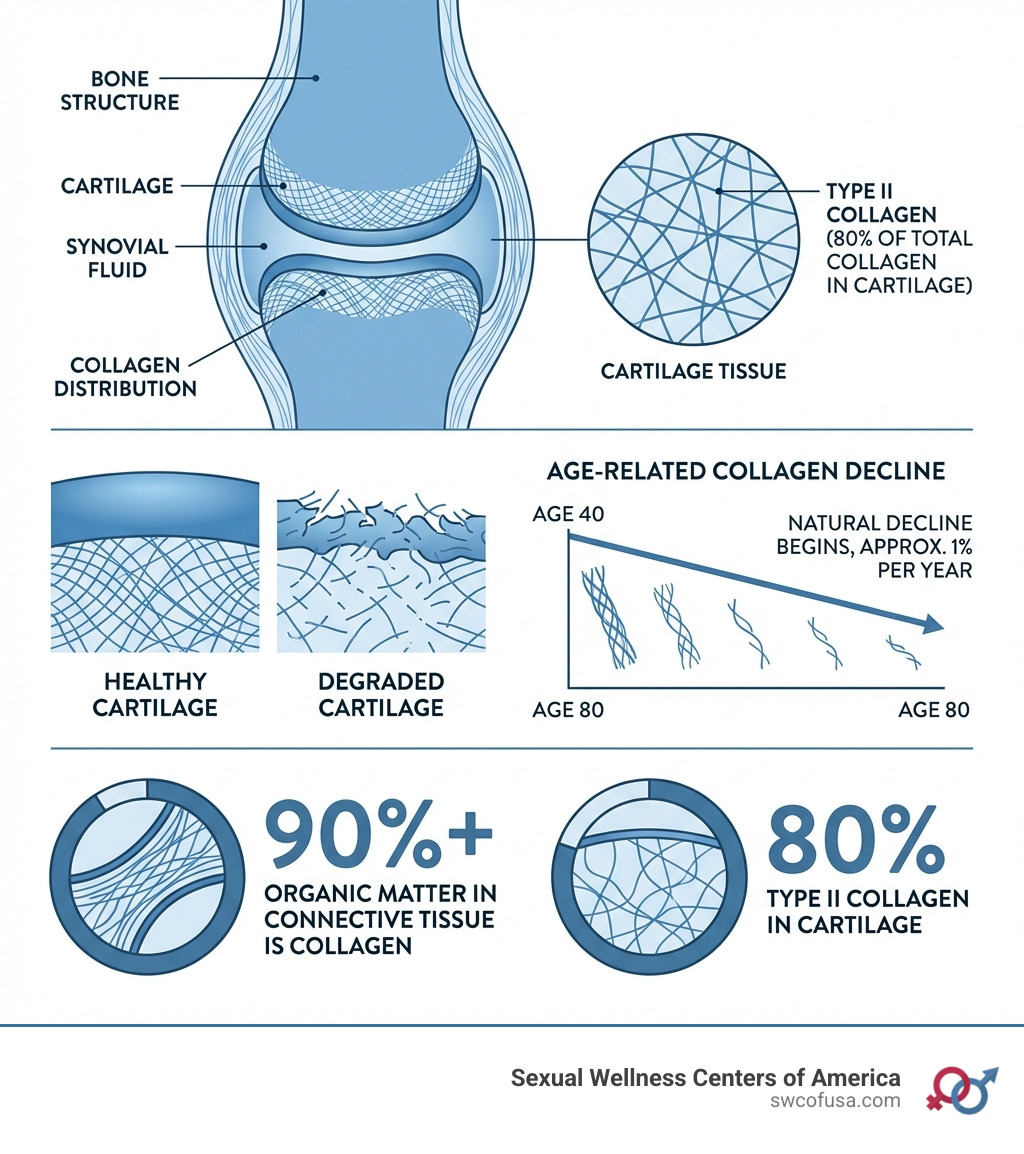
- Collagen represents more than 90% of the organic matter in tendons and ligaments
- Type II collagen accounts for about 80% of total collagen in cartilage
If you’re experiencing joint discomfort, whether from osteoarthritis, athletic activity, or age-related changes, understanding how collagen peptides work can help you make informed decisions about supplementation.
Your joints face constant stress. Every step you take, every weight you lift, every movement you make depends on healthy cartilage and connective tissue. As we age, natural collagen production declines by about 1% per year after age 40. This breakdown accelerates with factors like inflammation, injury, and chronic wear.
The good news? Research shows that supplementing with specific forms of collagen can help support joint structure and reduce discomfort. Unlike topical applications, oral collagen peptides are absorbed into your bloodstream and can actually reach your joint tissues.
As Jeff Nuziard, CEO of Sexual Wellness Centers of America, I’ve seen how joint mobility impacts overall wellness and quality of life, which is why understanding the science behind collagen peptides for joints is essential for anyone seeking to maintain an active lifestyle. Our comprehensive approach to wellness includes nutritional strategies that support musculoskeletal health alongside our specialized treatments.
Quick collagen peptides for joints terms:
Understanding Collagen Peptides for Joints
To understand how collagen peptides for joints work, we first have to look at what collagen actually is. It is the most abundant protein in our bodies, acting as the “glue” or biological scaffolding that holds everything together. While there are 28 known types of collagen, Type I and Type II are the most critical for our musculoskeletal system. Type I is found in our bones and tendons, while Type II is the primary structural protein in our cartilage.
When we talk about supplements, we aren’t just eating raw collagen (which would be very hard to digest). Instead, we use specific derivatives. Scientific research on collagen derivatives in osteoarthritis has shown that the molecular structure of these supplements determines exactly how they help our joints.
Bioavailability of Collagen Peptides for Joints
The term “bioavailability” refers to how well our bodies can absorb and use a substance. Regular collagen molecules are huge and difficult for the gut to process. This is where hydrolyzed collagen peptides come in. Through a process called enzymatic hydrolysis, large collagen fibers are broken down into tiny chains of amino acids called peptides.
These peptides have a very low molecular weight (typically less than 10 kilodaltons), which allows them to be rapidly absorbed through the intestinal wall. Once in the bloodstream, they aren’t just broken down into random amino acids; they often stay in bioactive pairs like Proline-Hydroxyproline. These pairs act as signaling molecules, traveling through the blood to reach joint tissues where they are needed most.
Difference Between Native and Hydrolyzed Forms
It is easy to get confused by the different labels on supplement bottles. We generally see two main forms:
- Hydrolyzed Collagen (Collagen Peptides): These are the “broken down” versions. We usually take them in larger doses (5 to 10 grams). Their primary job is to provide the building blocks for new cartilage and to signal our cells to start repairing the extracellular matrix.
- Native Type II Collagen (Undenatured): This form is kept in its original “triple helix” structure. Because it isn’t broken down, we take much smaller doses—typically just 40mg. It doesn’t work by providing building blocks; instead, it works through “oral tolerance.” It interacts with the immune system in the gut to help turn off the inflammatory response that attacks our joints.
Both forms of collagen peptides for joints have shown clinical success, but they approach the problem of joint pain from two different biological angles.
The Biological Mechanism of Joint Support
How do these tiny peptides actually make your knees feel better? It isn’t magic; it’s cellular communication. When we ingest collagen peptides for joints, we are essentially sending a message to our cartilage-producing cells, known as chondrocytes.
Accumulation in Cartilage Tissue
One of the most fascinating aspects of collagen peptides for joints is their ability to “target” specific tissues. Studies using radioactively labeled collagen have shown that after ingestion, these peptides actually accumulate in the cartilage. They don’t just wander aimlessly through the body; they find their way into the joint space. Once there, they increase the metabolic response of the chondrocytes, encouraging them to maintain and repair the tissue that cushions our bones.
Stimulation of ECM Macromolecules
The “cushion” in your joints is called the Extracellular Matrix (ECM). It is made up of water, collagen, and macromolecules called proteoglycans. Think of proteoglycans as the “springs” in a mattress and collagen as the “fabric.”
Research suggests that collagen peptides for joints stimulate the synthesis of these ECM macromolecules. Specifically, they induce:
- Type II Collagen Production: Strengthening the structural framework of the cartilage.
- Proteoglycan Synthesis: Improving the shock-absorbing capabilities of the joint.
- Chondrogenic Differentiation: Encouraging precursor cells to turn into healthy, active cartilage cells.
By boosting these biological processes, collagen peptides help maintain the structural integrity and density of our joints, which is vital for long-term bone healing and mobility.
Clinical Evidence and Therapeutic Benefits
We don’t just rely on theories; the clinical evidence for collagen peptides for joints is robust. Over the last decade, thousands of studies have been published exploring how these supplements impact real people with real pain.
Impact on Osteoarthritis Symptoms
Osteoarthritis (OA) is a “wear and tear” disease where the cartilage slowly breaks down, leading to pain, stiffness, and loss of function. For many, the standard treatment involves NSAIDs (like ibuprofen), which can have harsh side effects on the stomach and kidneys over time.
Scientific research on the safety and efficacy of undenatured collagen has demonstrated that 40mg of native Type II collagen can be more effective than the combination of glucosamine and chondroitin. In various trials, patients taking collagen reported:
- Significant reductions in the WOMAC score (a standard measure of OA pain and function).
- Improved “articular comfort” during daily activities like climbing stairs or walking.
- Decreased levels of inflammatory cytokines, which are the chemical “fire” that causes joint swelling.
For those looking for peptide therapy for arthritis, adding oral collagen peptides is often a foundational step in a comprehensive management plan.
Benefits for Athletes and Active Adults
You don’t need a medical diagnosis to benefit from collagen peptides for joints. Athletes and “weekend warriors” place immense stress on their ligaments and tendons. Since collagen makes up over 90% of the organic matter in these tissues, supplementation can be a game-changer for recovery.
In a famous 24-week study on varsity athletes, those taking collagen hydrolysate experienced significantly less joint pain during activity compared to a placebo group. They also required fewer “alternative therapies” (like ice packs or extra physical therapy) to manage their discomfort. By supporting ligament strength, collagen peptides help prevent the micro-tears that often lead to more serious injuries.
Optimizing Supplementation: Dosage and Selection
Not all collagen is created equal. To get the best results, we need to look at the specific dosage and the quality of the source.
Recommended Daily Intake for Maximum Efficacy
The “right” dose depends entirely on which form of collagen you are using. Based on the latest clinical trials, we recommend the following:
| Collagen Type | Recommended Daily Dose | Primary Goal |
|---|---|---|
| Native Type II (Undenatured) | 40 mg | Inflammation control and immune support |
| Hydrolyzed Collagen Peptides | 5 g to 10 g | Building blocks and cartilage repair |
| Specific Bioactive Peptides | 2.5 g to 5 g | Targeted tendon or ligament support |
Consistency is key. You cannot take collagen for three days and expect your joints to feel brand new. Most studies show that the “magic window” for results is between 12 and 24 weeks. This gives the body enough time to accumulate the peptides and begin the slow process of remodeling the cartilage.
Choosing High-Quality Collagen Peptides for Joints
When we evaluate supplements for our clients at Sexual Wellness Centers of America, we look for three things: source, purity, and processing.
- Source: Bovine (cow) collagen is excellent for Types I and III, while chicken sternal cartilage is the best source for Type II. Marine (fish) collagen is often praised for its high absorption rates due to its very small peptide size.
- Purity: Look for products that are free from fat, sugar, cholesterol, and unnecessary additives. Independent testing by organizations like ConsumerLab can help ensure your supplement isn’t contaminated with heavy metals like cadmium.
- Added Ingredients: Vitamin C is a crucial co-factor. Your body cannot physically produce new collagen without it. Choosing a supplement that includes Vitamin C or taking it alongside a citrus-rich diet will significantly improve your results.
Comparing Collagen to Glucosamine and Chondroitin
For decades, glucosamine and chondroitin were the “gold standard” for joint health. However, recent head-to-head trials suggest that collagen peptides for joints might be taking the lead.
The main difference lies in the mechanism. Glucosamine provides the raw materials for joint fluid, but it doesn’t always address the underlying structural breakdown or the immune system’s role in inflammation. Collagen peptides—especially native Type II—work through “oral tolerance.” They teach your immune system to stop attacking its own cartilage, providing a more comprehensive approach to inflammation control.
Many people find that using both—collagen and traditional joint supplements—creates a synergistic effect that provides better relief than either one alone.
Frequently Asked Questions
Are there any side effects to collagen peptides?
In clinical trials, collagen peptides for joints are remarkably safe. They are a food-derived protein, and the FDA generally recognizes them as safe (GRAS). A very small percentage of people report mild digestive issues like bloating or a feeling of fullness, but serious adverse events are virtually non-existent.
How long does it take to see results for joint pain?
Patience is required! While some people notice a difference in 30 days, the most significant improvements in mobility and pain reduction typically occur after 3 to 6 months of daily use. Think of it as a long-term investment in your musculoskeletal health.
Can I get enough collagen from food alone?
It’s difficult. While bone broth and organ meats are rich in collagen, they don’t provide the standardized, low-molecular-weight peptides found in supplements. To get the 5-10 grams of targeted peptides used in clinical studies, you would have to consume massive amounts of bone broth daily, which isn’t practical for most people.
Conclusion
Maintaining joint health is about more than just avoiding pain; it’s about preserving the freedom to move, play, and live life to the fullest. Whether you are an athlete looking to stay in the game or someone managing the early signs of osteoarthritis, collagen peptides for joints provide a scientifically validated tool to support your body’s natural repair processes.
At Sexual Wellness Centers of America in Colleyville, TX, we believe that true wellness is holistic. We don’t just look at one symptom; we look at the whole person. Our personalized wellness plans often start with detailed hormone and vitamin panels to identify exactly what your body needs to thrive.
From our innovative recovery technologies like REGENmax® to our specialized treatments like HEshot®™ and SHEshot®™, we are dedicated to helping you optimize every aspect of your health. If you’re ready to move more comfortably and reclaim your vitality, we invite you to explore how our peptide therapy benefits can complement your joint health journey.
Your joints are the hinges of your life—let’s make sure they stay strong, flexible, and ready for whatever comes next.
References and Research Sources:
- Role of Collagen Derivatives in Osteoarthritis and Cartilage Repair
- Safety and Efficacy of Undenatured Type II Collagen
- Collagen Peptides and Exercise Recovery Systematic Review
- Efficacy of Low-Molecular-Weight Collagen Peptides in Knee OA