
Why the Ventrogluteal Injection Is the Safer Choice for Intramuscular Shots
An injection ventrogluteal is an intramuscular (IM) injection delivered into the gluteus medius muscle on the side of the hip — and it is widely considered the safest gluteal site for adults.
Quick answer: Why choose the ventrogluteal site?
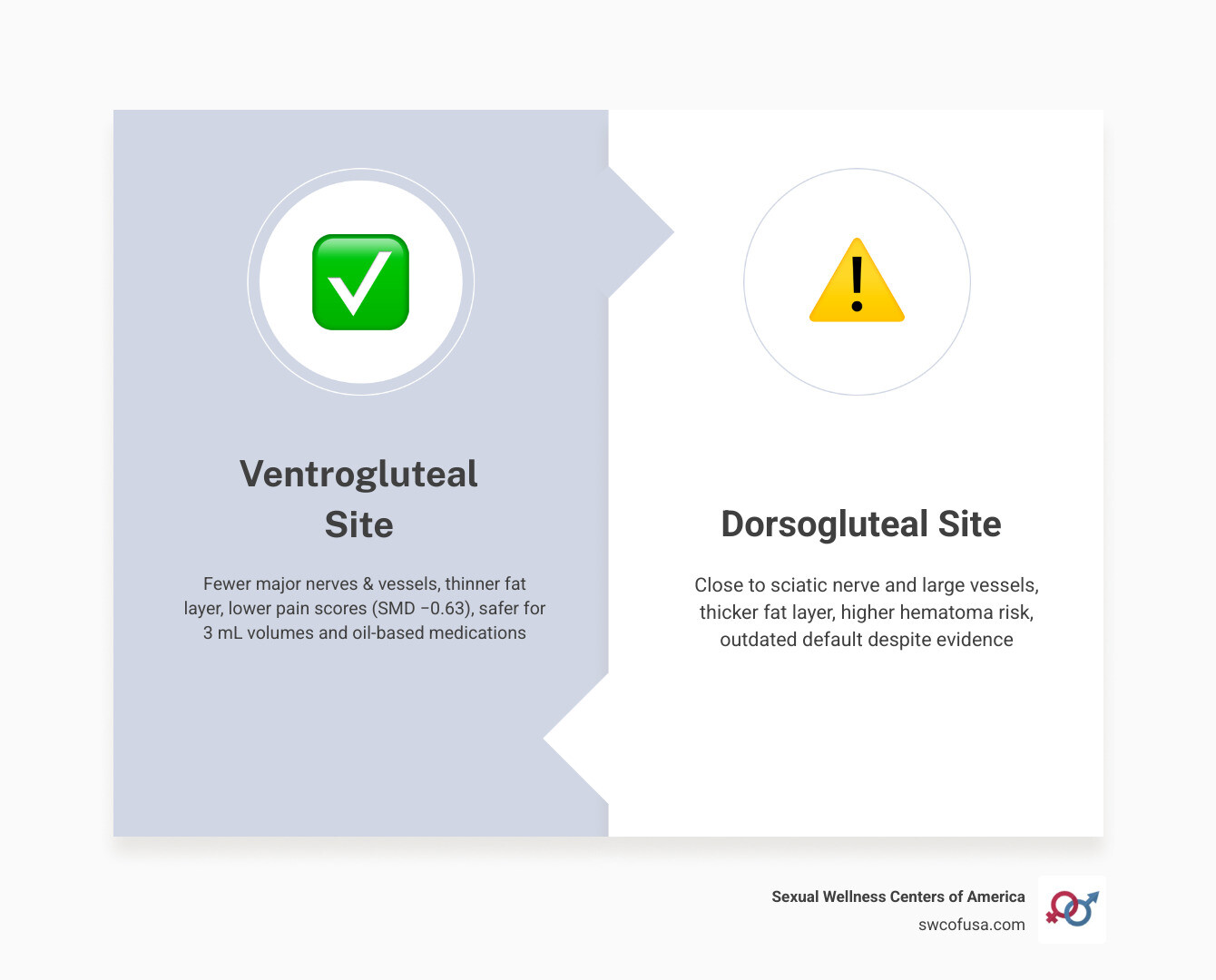
- Less pain — clinical data shows significantly lower pain scores vs. the dorsogluteal site (SMD = −0.63)
- Less bleeding and bruising — lower hematoma risk at both 48 and 72 hours post-injection
- Thinner fat layer — medication is more likely to actually reach the muscle
- Fewer major nerves and blood vessels — lower risk of sciatic nerve injury or vascular damage
- Holds up to 3 mL — suitable for larger volumes, oily medications, and long-acting injectables
Despite these advantages, the ventrogluteal site is still underused. Research shows that 74% of nurses have never preferred it, and 80% were unaware it is recommended in the evidence-based literature. Meanwhile, the dorsogluteal site — which sits dangerously close to the sciatic nerve — remains the default in many clinical settings.
Worldwide, 12 billion injections are administered every year, with over 95% for therapeutic purposes. Getting the site right isn’t a minor detail — it directly affects patient safety, comfort, and treatment outcomes.
I’m Jeff Nuziard, CEO of Sexual Wellness Centers of America, where ventrogluteal injection technique is a core part of how we deliver hormone therapy and other IM-based treatments safely and effectively. In this guide, I’ll walk you through everything you need to know to understand, locate, and use this site with confidence.
What Is the Ventrogluteal Site and Why Is Injection Ventrogluteal Preferred?
The ventrogluteal, or VG, site sits on the lateral hip over the gluteus medius and gluteus minimus. In plain English: it is the side-hip muscle zone, not the upper buttock area many people picture when they hear “glute injection.”
Why do we prefer it? Because anatomy is doing us a favor here.
Compared with the dorsogluteal, or DG, site, the ventrogluteal area is farther from the sciatic nerve and major blood vessels. It also tends to have a thick, dependable muscle target with a thinner fat layer on top. That combination matters. It improves the odds that medication actually reaches muscle tissue instead of sitting in subcutaneous fat where absorption can be less reliable.
For a broader overview of IM therapy, see our page on IM injections.
| Feature | Ventrogluteal | Dorsogluteal |
|---|---|---|
| Location | Side of hip | Upper outer buttock |
| Main muscle | Gluteus medius/minimus | Gluteus maximus region |
| Sciatic nerve risk | Lower | Higher |
| Major vessel risk | Lower | Higher |
| Fat thickness | Usually thinner | Usually thicker |
| Pain and bruising | Lower in pooled evidence | Higher in pooled evidence |
| Best use | Larger-volume, oily, irritating IM meds | Generally less preferred |
Anatomy of the ventrogluteal site vs dorsogluteal site
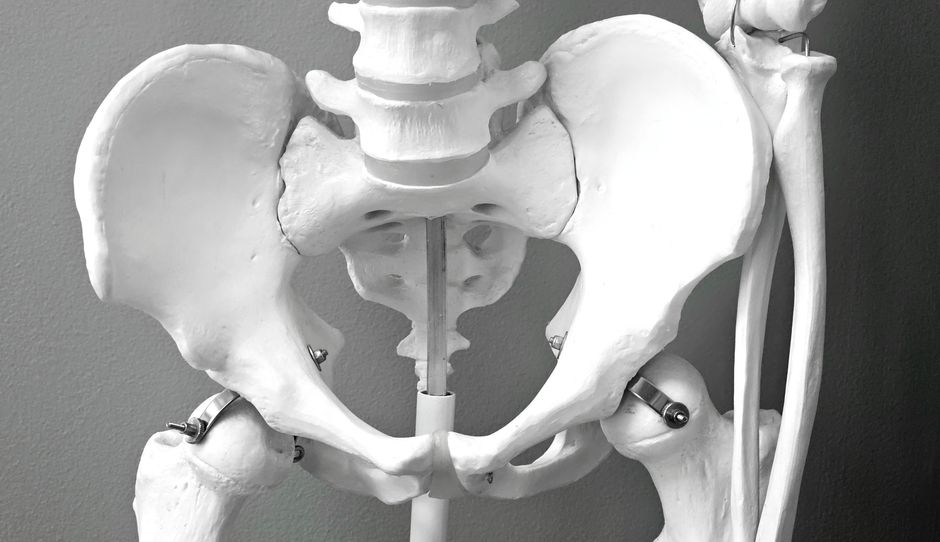
The VG site is identified using bony landmarks, which is one reason it is so reliable once you know the method.
The three key landmarks are:
- Greater trochanter
- Anterior superior iliac spine
- Iliac crest
The classic “V method” works like this:
- Place the palm of the opposite hand over the patient’s greater trochanter.
- Point the index finger toward the anterior superior iliac spine.
- Sweep the middle finger back along the iliac crest.
- The injection goes in the center of the V-shaped triangle formed by the fingers.
This method uses fixed anatomy instead of guesswork. That is a big upgrade from the old “upper outer quadrant” shortcut often used for dorsogluteal injections.
If you want a deeper look at landmarking, our guide on how to find the ventrogluteal site without getting lost is a helpful companion. For research on tissue depth and site selection, see Scientific research on gluteal site selection.
Evidence showing injection ventrogluteal lowers complications
This is not just “preferred” because someone said so in nursing school. Evidence supports it.
A systematic review and meta-analysis comparing VG with DG injections found that the ventrogluteal site was associated with:
- Lower pain scores: SMD = -0.63
- Lower bleeding: SMD = -3.46
- Lower hematoma risk at 48 hours: SMD = -0.25
- Lower hematoma risk at 72 hours: SMD = -0.16
The same body of evidence also found thinner subcutaneous tissue at the ventrogluteal site on average, which helps explain why IM delivery may be more dependable there.
There was not a clear statistically significant difference in every study for every outcome, and that nuance matters. But overall, the safety and comfort profile leans toward VG, not DG.
For a clinical overview of IM injection safety, see Scientific research on IM injection complications.
When ventrogluteal is a better choice than other IM sites
The ventrogluteal site is especially useful when we need:
- Up to 3 mL in a typical adult
- A site for oil-based or viscous medications
- A site for irritating medications
- A dependable site for long-acting injectables
- Better safety margins than dorsogluteal offers
Compared with other IM sites:
- Deltoid is great for small volumes, especially vaccines, but not ideal for larger or irritating injections.
- Vastus lateralis is excellent in infants and in some adults when hip access is limited.
- Ventrogluteal often shines for adults needing moderate to larger IM volumes.
If the medication is thick, depot-style, or repeated over time, VG is often a very sensible choice. We cover that in more detail in where to give your next IM injection.
How to Locate and Perform a Safe Injection Ventrogluteal
Knowing that the VG site is safer is one thing. Hitting it accurately is the real skill.
The good news: once you understand the landmarks, the process becomes very teachable and repeatable.
Step-by-step ventrogluteal landmark technique
A safe landmarking sequence looks like this:
Position the patient.
- Side-lying or supine positions usually work best.
- A relaxed hip makes landmarks easier to feel.
Choose the correct hand.
- Use the left hand for the patient’s right hip.
- Use the right hand for the patient’s left hip.
Find the greater trochanter.
- Place the palm or heel of the hand over it.
Place the index finger on the anterior superior iliac spine.
Fan the middle finger back along the iliac crest.
Identify the triangle.
- The center of the V between the index and middle fingers is the target zone.
Prep the skin and inject at 90 degrees.
This is much easier to learn visually, so our article on ventrogluteal landmarks can help reinforce the hand placement.
Best-practice technique: Z-track, air-lock, aspiration, and injection speed
For many IM medications, technique matters almost as much as site selection.
Best practices include:
- Use the Z-track method when possible.
- Insert the needle at a 90-degree angle.
- Deliver the medication slowly, around 10 seconds per mL.
- Leave the needle in place for about 10 seconds after injection before withdrawing.
- Withdraw smoothly and release displaced skin if using Z-track.
Why Z-track? Because it shifts the skin and soft tissue so the medication path seals off when the tissue returns to place. That helps reduce leakage into subcutaneous tissue and may reduce irritation.
What about air-lock? Some clinicians use a small air bubble behind the medication to help clear the needle track, especially with certain irritating or oily medications. That technique should follow product instructions and clinic policy, not improvisation.
What about aspiration? Current guidance has moved away from routine aspiration for many recommended IM sites. Some references reserve aspiration only for dorsogluteal injections. In practical terms, clinic policy and medication-specific guidance should decide this point. The larger lesson is simple: routine IM technique has evolved, and older habits are not always best practice.
For a stepwise nursing reference, see Scientific research on nursing injection technique.
Needle gauge, length, and volume selection
There is no one-size-fits-all needle. The right choice depends on the patient’s body habitus and the medication.
Common guidelines:
- 22-25 gauge for aqueous solutions
- 18-21 gauge for viscous or oil-based solutions
- 1 inch needle for many average adults
- 1.5 inch needle for larger adults or when more tissue depth must be traversed
General volume guidance for ventrogluteal injections in average adults:
- Up to 3 mL is commonly cited
- In select contexts, some sources discuss slightly larger volumes, but 3 mL is the conservative standard
Needle length matters because too short can leave medication in fat, while too long can raise the risk of contacting deeper structures. That balance is why patient assessment comes first.
For more general technique, see our guide on giving an IM injection step by step.
Patient Factors That Change Site Selection
The “best” site is not chosen in a vacuum. It is chosen for that patient, for that medication, on that day.
Important variables include:
- BMI
- Distribution of adipose tissue
- Sex-based body composition differences
- Muscle mass
- Mobility and positioning
- Injection frequency
- Medication viscosity and volume
How BMI and adipose tissue affect intramuscular success
This is where things get interesting.
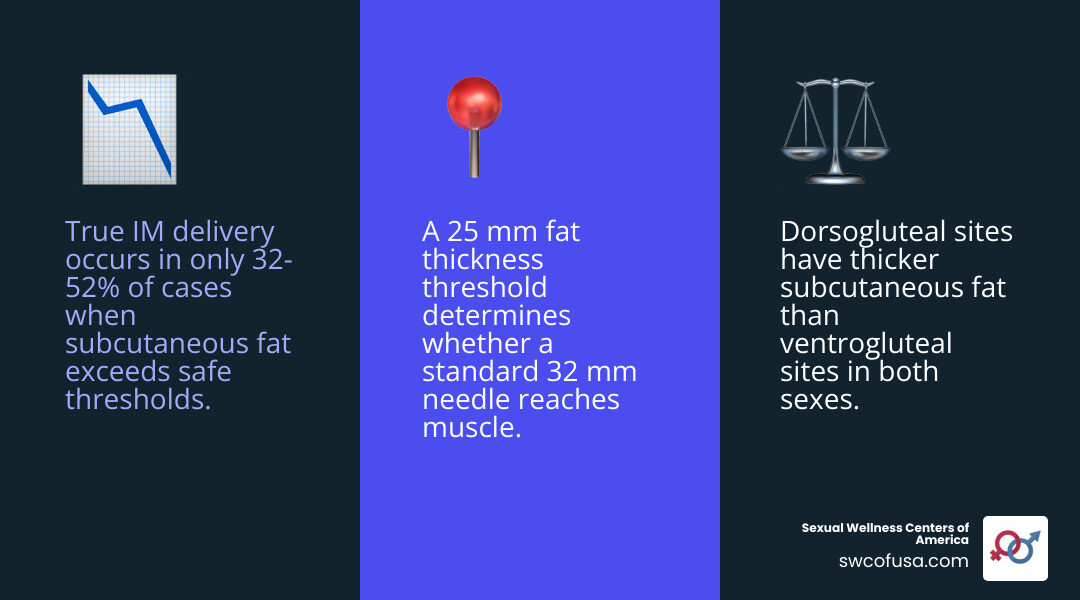
Research has shown that true intramuscular delivery is not guaranteed just because a needle went in. One source notes true IM placement may occur in only 32% to 52% of cases, with especially low rates in females in some settings. That sounds alarming because it is.
A major reason is tissue depth. If subcutaneous fat is too thick, a standard needle may never reach muscle.
Research comparing VG and DG sites found:
- Dorsogluteal tissue is generally thicker overall
- Subcutaneous fat is generally thicker at DG than at VG
- Females tend to have thicker subcutaneous fat at both gluteal sites than males
- For a standard 32 mm needle, successful IM delivery depends on both fat thickness and total tissue depth
One practical threshold discussed in the literature is that subcutaneous fat ideally should be under about 25 mm for a standard 32 mm needle to reliably reach muscle. On the flip side, if total tissue depth is too shallow, bone contact becomes a concern.
That is why landmarking plus individualized needle selection matters. For more on the evidence, see Scientific research on anthropometrics and injection outcomes.
Choosing between ventrogluteal, deltoid, and vastus lateralis
A quick practical comparison:
Ventrogluteal
- Best for many adult IM medications
- Better for larger volumes
- Good for oily, irritating, or depot medications
- Safer around major nerves and vessels
Deltoid
- Best for small-volume injections
- Common for vaccines
- Less forgiving for larger or irritating medications
Vastus lateralis
- Often preferred in infants and young children
- Useful when hip sites are not practical
- A strong backup site in adults too
So if we are dealing with a routine vaccine, deltoid often makes sense. If we are giving a thicker medication or a larger dose in an adult, ventrogluteal usually deserves serious consideration.
For a side-by-side overview, see Scientific research on IM site comparison.
Medication-specific considerations for ventrogluteal use
The VG site is particularly helpful for:
- Depot medications
- Hormones
- Antibiotics requiring deep IM delivery
- Oil-based products
- Medications known to irritate tissue
- Long-acting formulations given repeatedly
Repeated dosing also brings up another issue: rotation. Using the same exact spot over and over is asking a lot from the tissue. Rotation helps reduce soreness, induration, and local irritation.
If you want more on longer-acting medications and gluteal injections, see depot gluteal injection guidance.
Why Many Clinicians Still Avoid the Ventrogluteal Site
If the evidence is strong, why is DG still so common?
Short answer: habit is stubborn.
Top barriers to ventrogluteal adoption include:
- Not knowing how to identify the site
- Fear of hitting bone
- Worry about hurting the patient
- Patient unfamiliarity or resistance
- Traditional teaching favoring dorsogluteal
- Lack of policy support
- Limited hands-on training
What the research says about low ventrogluteal adoption
One study on practice change found striking numbers:
- 34% of nurses frequently used the dorsogluteal site
- 74% never preferred the ventrogluteal site
- 80% were not informed that literature recommends VG use
- 56% always used dorsogluteal before training
That is a classic evidence-practice gap. People often keep doing what they were first taught, especially when the old method feels faster or more familiar.
For the original training-focused study, see Scientific research on changing ventrogluteal practice.
Common fears: bone contact, wrong landmarks, and hurting the patient
Research found the most common reason for avoiding VG was simple: “I do not know how to identify the site.” Other major fears included reaching bone tissue and patient refusal.
Those concerns are understandable. Nobody wants an anatomy pop quiz with a needle in hand.
But they are also very trainable problems. Landmarking confidence improves with repetition, coaching, and anatomy-based teaching. In many cases, the fear is larger than the actual risk when proper technique is used.
We discuss complication prevention in gluteal injection risks.
Why dorsogluteal remains common despite poorer safety data
DG persists because it is familiar, not because it is better.
Common reasons include:
- Legacy education
- Workflow shortcuts
- Provider preferences
- Institutional culture
- Weak policy language
- Lack of competency checks
But familiarity is not the same as safety. The dorsogluteal site remains closer to the sciatic nerve and carries a more concerning complication profile. If a patient develops post-injection limping, weakness, or neuropathic pain, that is not a “minor oops.”
For a focused discussion, see why the dorsal gluteal site is dangerous for IM injection.
How Education and Policy Change Increase Ventrogluteal Use
Changing individual technique is helpful. Changing systems is better.
Training outcomes: knowledge, confidence, and anxiety
Targeted education works, at least for knowledge.
In one intervention study, nurses’ mean knowledge scores rose from 12.40 +/- 6.89 before training to 21.80 +/- 1.95 after training, a statistically significant improvement. That is a major jump.
Interestingly, anxiety did not drop significantly. So education alone may not fully calm the “what if I miss?” feeling. That is why hands-on repetition matters.
The best training programs include:
- Anatomy review
- Demonstration
- Practice on models
- Supervised real-world use
- Reinforcement with written guidelines
For the data, see Scientific research on ventrogluteal training outcomes.
Institutional strategies that actually change practice
Organizations that successfully shift from DG to VG tend to use more than a memo and wishful thinking.
Strategies that help include:
- Standardized guidelines naming VG as the preferred gluteal IM site
- Onboarding that teaches VG first, not as an optional extra
- Competency validation with landmark demonstration
- Provider education to reduce mixed messages
- Monthly chart audits or compliance tracking
- Patient education scripts so the site feels normal, not strange
In real-world practice change discussions, audit-and-feedback systems have reduced incorrect site selection dramatically. That tells us policy works best when paired with measurement.
What to include in a ventrogluteal injection policy
A solid policy should include:
- Preferred-site language favoring ventrogluteal for appropriate adult gluteal IM injections
- Clear contraindications, such as infection, trauma, or compromised tissue at the site
- Standard landmarking method
- Needle gauge and length selection by body habitus and medication type
- Volume limits
- Z-track expectations
- Guidance on aspiration based on current evidence and medication-specific needs
- Documentation standards
- Adverse-event response steps
- Rotation guidance for repeated injections
For additional practical guidance, see our gluteal injection site complete guide.
Frequently Asked Questions About Injection Ventrogluteal
Is the ventrogluteal site safer than the dorsogluteal site?
Yes, in general. The ventrogluteal site is farther from the sciatic nerve and major vessels and has better evidence for lower pain, bleeding, and hematoma risk. That is why many evidence-based resources describe it as the safest gluteal IM option.
What needle size is best for a ventrogluteal IM injection?
It depends on the medication and the patient.
- 22-25G is common for aqueous solutions
- 18-21G may be better for viscous or oil-based medications
- 1 inch works for many average adults
- 1.5 inch may be needed for larger adults or deeper tissue
The goal is simple: long enough to reach muscle, not so long that you create unnecessary risk.
Can obese or high-BMI patients still receive a ventrogluteal injection?
Yes, often they can. But site selection and needle length must be individualized. High BMI can increase tissue depth, which may require a longer needle or, in some cases, a different IM site. Good landmarking becomes even more important here.
Conclusion
The case for injection ventrogluteal is strong: better anatomy, better safety margins, and better comfort outcomes than the traditional dorsogluteal approach in many adult IM scenarios.
For us, this is not just academic. At Sexual Wellness Centers of America in Colleyville, TX, careful IM technique supports safer, more consistent delivery of treatments that may include hormone-based therapies and other injectable care. Evidence-based practice is not flashy, but it is exactly what patients deserve.
If you want to learn more about treatment options and professional IM care, visit our IM injections service page in Colleyville, TX.